The Fact of Fingerprints


Is this a Paul Simon song, or is it a Los Lobos song? Who can say?

Of all the symptoms I’ve experienced over the past six years, fingerprint destruction has to be the weirdest.

I first heard it mentioned as something that happens in ME/CFS within the first couple years I was ill. I remember looking at my fingertips, which looked fine to me, and thinking to myself that maybe this belonged with the unreliable WAKE UP SHEEPLE kind of information I’d seen about the disease.

When I went to see Cheney last year, during the physical exam he did, he said to his assistant, “One to two plus fingerprint changes.” So I asked him what he was seeing, because I still didn’t know what he was looking at. He told me the horizontal lines across my fingerprints were what he was noting, and that the degree to which I had them wasn’t normal. At the time, I still didn’t really see what he was seeing. I did know that since I’ve been ill, I’ve developed a permanent case of “prune hands.” My fingers have vertical creases that make them always look like I’ve just gotten out of the bathtub.

At right is a slide from a talk given by Dr. Cheney at the 2010 Invest in ME conference, in which he theorizes that the loss of fingerprints is caused by a high degree of oxidative stress and/or immune activation, both of which occur in ME/CFS. Apparently, immune activation can produce elastase and MMP-9, the former of which breaks down elastin (which is what gives skin its elastic quality) and the latter of which breaks down collagen.

Now I see it. My fingertips look exactly like that.

It’s actually a bit uncomfortable to use the trackpad on my laptop. I don’t know if it’s because my fingertips are so smooth or because of changes in the elastin and collagen, but it doesn’t feel good to slide my fingers along the surface of the trackpad, and that didn’t use to be the case.

Additionally: I bought this laptop in 2007. It has a fingerprint scanner you can use to log in. I set it up when I first got the machine, and I never use it, because I have an admin account that you log into with a password rather than a fingerprint scan. But the other day, I couldn’t get into my usual admin account, so I went to log in using the fingerprint scanner.

No matter how many times I tried to scan my finger, I couldn’t get it to work.
Posted in ME/CFS | Tagged , | 33 Comments

Fever! (Ba-da-bump)


If you’ve never seen Rita Moreno and Animal’s version of “Fever” before, enjoy.

I’ve had a fever for five days now. It’s nothing major thus far – 99.0 is as high as it’s gotten – but I usually run around 97.5. It is making me feel more flattened than usual (and usual is pretty flattened). To deal with it, I’ve been doubling up on my inosine, which has antiviral properties. And I’m keeping Chimp busy running back and forth to the freezer for cold compresses.

The temperature came on on Tuesday, with no other symptoms, which seemed slightly weird to me. Not totally weird, because I’ve had chronic fever before. When I was first ill in 2004, I had a fever of 99.5 for about a month, and over the next few months, it gradually subsided.

So I’ve been trying to figure out what was causing it and what to do. I had forgotten my artesunate for a few days, and I was thinking that might be it, because it acts as an antiviral, and maybe missing it for a few days was just enough to give some viral nasty enough of a toehold to get reactivated. Then last night my throat started to hurt.

Well, was that a load off my mind. A regular old rhinovirus? That I will take. And I haven’t had one since 2007, maybe 2006. But where did it come from? Neither Chimp nor my mom, who was visiting when it started, have been sick. They’re both very diligent about washing when they come back into the house, so I don’t think it came directly from either of them.

And then I remembered something: On Tuesday morning, I got a container of mixed nuts out of the pantry that my mom had gotten from Sam’s Club, opened it, and ate some. I remember that because it was the first time in a while I’d felt well enough to get myself a snack. That evening, the fever started. So maybe somebody with a bug handled the container.

I guess this means we will have to put all our snack foods through an autoclave, at least until sick people start staying at home where they belong.

Posted in ME/CFS | Tagged , , , | 3 Comments

The CFIDS Association of America’s Foot-in-Mouth Disease

The CFIDS Association of America should be having a banner week. Last Friday, the scandalous PACE trial, promoting cognitive behavioral therapy and graded exercise therapy for ME/CFS, came out in The Lancet, which was an opportunity to come out swinging if ever there was one.

Then Wednesday evening, a study of spinal fluid proteins appearing in PLoS One was released, which found distinct proteomes differentiating ME/CFS and Lyme Disease. It made it all the way to the CBS Evening News.

Surely this should be a triumphant week for a patient advocacy organization, right? Well, look what we got from the CAA.

In reference to PACE, this is President Kim McCleary’s quote to CNN:

“I think it would be challenging, at least in the U.S. system, to purchase the services that they’ve tested in this trial,” she said in a telephone interview.” The alphabet soup of acronyms that represent the interventions used in Britain is “just not something that our health care service offers, is reimbursable, or is really available here,” McCleary said.

Notice the total lack of mentions of the characteristic symptom of ME/CFS, which is post-exertional malaise – feeling worse after even minor exercise, and how dangerous pushing limits is in this illness. Also notice the lack of mentions of the clearly neuroimmune nature of ME/CFS, or the finding that up to 98% of those with ME/CFS are XMRV positive. Well, this got the community hopping mad (or it would have, if any of us had enough energy to hop). Don’t worry, though, they had that spinal fluid protein study to comment on to redeem themselves, right? So Suzanne Vernon, who used to work at the CDC (remember their great record on ME/CFS?) gave this quote to the Wall Street Journal:

“It’s difficult to have a diagnostic test based on spinal fluid,”  says Suzanne Vernon of the CFIDS Association of America, a CFS patient advocacy group, who was a consultant on the PLoS study. “You can’t just go poking everyone in the spine.”

Yes, Ms. Vernon. For instance, we can’t go poking everyone with suspected meningitis in the spine, can we? She also fails to mention that there are a great many other already known laboratory findings that are characteristic of ME/CFS.

But those two quotes aren’t the most amusing part of this week. A member of the Phoenix Rising forums thought to put up a poll asking how people thought the CAA was doing, and, well – I’ll just let you click and see for yourself how it’s running.

I can tell you, if I had ever given them any money, I would be asking for it back right about now.

Edited to add: Need yet more evidence of where the CAA is coming from and who their friends are? Check out this post by Charlotte von Salis at CFS Central. She attended the recent in-house lecture “Chronic Fatigue Syndrome:  Is there a virus?” on February 22 at NIH and notes that Dr. Fred Gill, graded exercise promoter, approves of the CAA. XMRV Global Action posted an advance look at Gill’s slides before the workshop – you can check them out here. When I went through them, I stopped counting at half a dozen demonstrably false statements.

Posted in ME/CFS | Tagged , , | 20 Comments

Fighting the PACE

Katie Couric is supposed to be doing a report on ME/CFS tonight on the CBS Evening News. The community is worried b/c the scandalous PACE trial of CBT and graded exercise, run by UK psychiatrist Simon Wessely, who has been promoting ME as a psychological problem of “aberrant illness beliefs” for twenty years, just made news five days ago.

We are trying to bombard CBS with messages about the danger of graded exercise and its ineffectiveness as a treatment for those with ME/CFS, and the clearly infectious nature of the illness. Below is my letter to Katie Couric. I think I’ve reached my typing limit for the day now.

Continue reading

Posted in Uncategorized | 19 Comments

Nest Feathers

We spend a lot of time in the house. Me, because I have to; Chimp, because he’s taking care of me, and because he likes to be around me. So we have been working on making it a pleasant place to be.

Before we moved to Pennsylvania, we didn’t spend much money on house stuff. We’d lived in a series of apartments the entire time we’d been together, and we had more than enough stuff to furnish an apartment. We also tended to not buy things for the house because it meant more things we’d have to pack up and move every time we relocated. Being a young academic is sort of like being a young ballplayer, or a member of the military. Many people live a few places doing postdocs or visiting assistant positions before finding a permanent spot. We moved to Kalamazoo, Michigan and then Fresno, California before settling here.

But since I was able to join Chimp in Pennsylvania (after being transported from Fresno to Indiana via air ambulance and living with my Mom for a year because I was too weak to be moved), we’ve been adding stuff. Some of it has been just decorating; some of it has been furnishing rooms we didn’t have before. We had to buy living room furniture anew, because I’m using our former living room couch in the dayroom. (It’s a famously comfortable couch, known for sending a friend’s husband off to slumberland every time we’d have a movie night together.)

It's perfect.

I’ve always been into vintage stuff, and we’ve continued that thread into the house as well. It’s cheaper – and definitely more interesting to us – than buying new. I’ve found a number of things on ebay, and the guys at Mostly Mod have been kind enough to let Chimp take pictures and to email back and forth with me.

Chimp, like me, likes old stuff, and he also takes a certain amount of pride in being “the weird people down the street.” And we are definitely accumulating some things to push us further into that category. Our two most recent ebay purchases are an enormous painting for the hall and a pair of lamps for the living room.

The painting is a Vanguard Studios one. Vanguard Studios is an interesting story. I knew I had seen the “Lee Reynolds” signature on thrift store paintings in the past, and when I saw one on ebay, I did a little more looking for information about the artist. Reynolds headed up Vanguard Studios starting in the 1960s, which produced thousands of what could fairly be termed “sofa paintings” – works in a fine-art style, produced assembly-line style by a staff of artists.

The fleece and antimacassar are for the cats.

The paintings bear a variety of signatures: “Lee Reynolds,” “Lee Burr” (Reynolds’s middle name), sometimes just “Reynolds.” It’s been fascinating to look at the paintings on ebay – you can very clearly tell exactly when they were painted, from the bold colors of the late 60s, to the earth tones of the 70s, to a stretch of abstract mauve-and-blue early 80s monstrosities. Our new acquisition is in the first category, and is a perfect match to the 1960s mustard-colored living room couch.

Does this room have enough pillows?

We also recently added a pair of lamps, above, to the living room. I have a serious weakness for chrome lighting of the Sputnik type, and these lamps have that in spades. These are replacing a pair of chrome column lamps that were a bit undersized for the room. Unfortunately, we haven’t been able to find fluorescent bulbs to fit these, so they will double as space heaters.

The addition of the painting has convinced me anew that when we have saved enough to reupholster the club chairs, we will do it in a near-electric blue that will coordinate well with the couch. If anybody has access to a good source for upholstery fabric, I’d love some help – it’s one of those things that the internet doesn’t seem to be good at yet.

Posted in House & Home, ME/CFS | Tagged | 5 Comments

Laura Hillenbrand: Unbroken & “A Sudden Illness”

Edit: Laura Hillenbrand tells me via Facebook that she’s never stopped speaking out about the illness. I have clearly missed those interviews, so I’ve corrected this entry.

Laura Hillenbrand – author of Seabiscuit and, most recently, Unbroken – is interviewed in Tara Parker-Pope’s “Well” blog at the NYT. The title – “An Author Escapes from Chronic Fatigue Syndrome” – is unfortunate and sort of misleading, but the interview is a good one. (Also: Don’t read the comments. The IT HAS TO BE LYME DISEASE! people are out in force. When all you have is a hammer…)

Ms. Hillenbrand has spoken publicly about ME/CFS before: Her award-winning essay “A Sudden Illness” appeared in the New Yorker in 2002.

I came upon that essay – which, by the way, took her six months to write – not long after I fell ill, and I’ve recommended it countless times. It is the best summation I’ve come across of so many aspects of the illness. I was struck, when I first read it, by how precisely alike our experience of the onset was. I, too, thought I had food poisoning. I also found it comforting, then, that my illness was not as severe as hers. And of course, in the intervening years, it has become so.

She does a beautiful job of conveying in “A Sudden Illness” what it was like in the years before the discovery of XMRV in late 2009. She lived many more of those than I did. It was a recipe for despair, to try to look for a cause or a reason. There was so much bad and conflicting information out there, and it was impossible to know what to believe.

I have had so many of the symptoms and experiences she describes therein – the weight loss, the mental confusion, the constant fever, the overwhelming vertigo, and the more frightening ones, too. I’ve had some dismissive doctors as well, but thankfully, by the time I fell ill, the illness had a name, if a trivializing one. Unfortunately, as she describes, after only a short time,  I, too, knew more about it than my doctors.

Ms. Hillenbrand is certainly the best-known person we have with ME/CFS. I certainly understand not wanting to make her career about the illness – my blog title is No Poster Girl, after all – but the fame her talent and hard work has brought her means she has the power to make people take notice of it in a way few of us with it do.

Laura Hillenbrand and I have one other thing in common, but it’s a lucky trait, not an unlucky one: We are both married to philosophers! Her husband, G. Borden Flanangan, teaches at American University.

Anyhow, I’ve kept you long enough. Go read that essay!

Posted in ME/CFS | 8 Comments

Bang.

Well, I suppose that’s the right way to start off an ME/CFS blog, isn’t it, with a big flaming crash?

This crash has the same cause as every one I’ve had since the end of 2007: Not sleeping.

After the night with the Zeo, my sleep cocktail failed. We had been increasing the Seroquel, which I was tolerating increasingly poorly. I’d always had to take beta blockers with it, because it increased my heart rate, but it was doing so more, I was needing more of it and it was doing less to help me sleep.

So there were three days of six hours a night, then three nights – I think – of no sleep at all. My memory’s not so good in there – when I don’t sleep, I don’t consolidate information, I forget when I usually do things that happen every day, like eat.

Anyway, at some point we connected with Dr. Cheney, (Chimp had to fill me in on the details here; I have no memory of this) and he said to move 40 mg. Baclofen, which I’d been using mostly as a backup, to the front of the night. So we did that, dropped the Seroquel out of the cocktail, and the weirdest thing happened: About two hours after I took the revamped cocktail, I was blindingly awake. Like I-just-shotgunned-a-gallon-of-coffee alert. I ring the bell by my bed, Chimp comes down, I’m telling him what’s up, and he says, “Why not take just a little of the Seroquel?” And I’m saying, no, no, I want to wait this out a little, but he convinces me. So I put it in my mouth, and almost instantly I feel this throbbing shift in my brain toward sleepiness. And it works.

I asked him the next day where he got the idea that a little Seroquel would help, and he said, “Honestly? The episode of M*A*S*H* where people get hemorrhagic fever. They’re under orders not to give them sodium, and they figure out to give them only a tiny amount.” So thanks, WTTG, for those endless reruns.

Reducing the Seroquel seems to have resulted in some stomach upset and some night sweats, which the internet tells me will pass. The crash itself has resulted in a fair bit of pain. I think today’s the first day since it began that I haven’t taken any pain pills during the day. That that’s passing is a good sign, and I seem to be recovering from it pretty steadily, though my brain definitely still feels a bit more leaden – less clever, less well-organized – than usual.

But to have a ME/CFS crash is not just painful; it’s a bad idea. Crashes are not a neutral occurrence; they make you worse temporarily at least, but sometimes there’s permanent function loss. too. My major crashes have happened in May 2004 (the dramatic onset of my illness), July 2006 (a heat wave and a power outage coincided to end my ability to commute to the office), December 2007 (when several months of insomnia resulted in my bedriddeness), and December 2008 (when more insomnia came pretty close to taking my life).

You can see why I don’t want to have any more of these.

My last few, as I said, have been caused by lack of sleep, but they can be caused by almost anything that pushes you beyond your limited capacity to deal – a minor illness, physical exertion, or physical or emotional stress of almost any kind.

The crash I had in July 2006, the one that ended my ability to commute to the office, was caused by a massive heat wave. The power went out, our apartment overheated, we had to get the cats out and to a hotel, and by the time I got to the lobby to check in, I was gasping for air and clinging to the desk so as not to collapse. We had tickets for CSNY the next night – I unwisely decided to go to the show. We left halfway through, and we had to get someone to get a wheelchair to take me from my seat to the door.

That’s a perfect example what you’re not supposed to do – I made that crash worse than it needed to be. Overdoing it physically has a particular name: it’s called a push-crash cycle – and you’re supposed to avoid the push so as not to have a crash.

Over time, what is a “push” for me has gotten smaller and smaller, though I’ve gotten better at respecting my boundaries, even as they’ve become more and more constraining. Some people are unlucky this way and get what seems like a progressive version of the disease. But I do seem to be coming back from this crash pretty steadily, I have an effective sleep cocktail again, and I hope it will work until I’m miraculously healed.

Posted in ME/CFS | 7 Comments

The Boring Stuff: What is ME/CFS?


We should probably have this straight before we go any further. What is ME/CFS? It’s a neuroimmune illness that affects pretty much all bodily systems.

The acronym ME/CFS stands for Myalgic Encephalomyelitis/Chronic Fatigue Syndrome. Let’s take that bit by bit:

  • Myalgic = muscle pain
  • Encephalo = relating to the brain
  • Myel = relating to the spinal cord
  • Itis = inflammation

So, taking it all together: Brain and spinal cord inflammation with muscle pain. Now, this is an old name, dating back to 1969. Such inflammation is has been found in autopsies of sufferers, but it’s not the cause, which is not yet known.

Now, Chronic Fatigue Syndrome. CFS, simply, is a name made up by a committee at the CDC in the late 80s after a U.S. outbreak. I assure you, I am not making this up.

If you know nothing about ME/CFS, this video by Giles Meehan and friends is a good start:

Is there any treatment? No FDA-approved ones, so most patients struggle to relieve only some of their symptoms at best. Without any real treatment, acting like you have mono and staying in bed is your best chance to get well…as long as you do it right away.

The tiny amount of funding this disease receives is absolutely shocking – only a few dollars per patient per year in the U.S.

One other thing: Do not bother with the Wikipedia entry for CFS. It has historically been an edit war with loggorhhea, mostly being won by those who deny the abundance of scientific evidence accumulated over decades showing abnormalities in the illness and who instead believe CFS is, roughly, malingering. Instead of that, you should read this editorial, “All in the Mind? Why Critics are Wrong to Deny the Existence of CFS.”

Additional resources:

The sordid history of CFS and the CDC is reviewed by NYT reporter David Tuller in this article.

The webseries ME/CFS Alert’s in-depth interviews capture many people in the forefront of work on the illness.

The best book for patients is the second edition of Erica Verillo’s CFS: A Treatment Guide.

There’s a gathering of the many medical abnormalities found in ME/CFS in this document.


Posted in Boring, ME/CFS | Tagged , , , | 24 Comments

One Pill Makes You Larger; 56 Make You a Freak

Before I got sick (I have a feeling I might start a lot of posts this way), I never took cold medicine, and hardly ever took an ibuprofen.

Above is my daily diet of tablets, capsules, elixirs, gels, and sprays these days. (Okay, maybe it’s not as high as 56; some of these are, admittedly, split for divided dosing.) It sometimes feels like there’s no room left in my stomach for actual food. My specialist is infamous for protocols as long as your arm, which include a mix of supplements and pharmaceuticals. The two-thirds on the left are during the day, the one-third on the right are for sleep.

And here’s the breakdown of what, when, and why. Click to embiggen.

Click through for the rest of the story. It’s a long ‘un. Continue reading

Posted in ME/CFS | Tagged , , , | 24 Comments

Zeo One; Jocelyn Zero

Last night I tried out my gift of the Zeo Sleep Coach for the first time. It didn’t go so well.

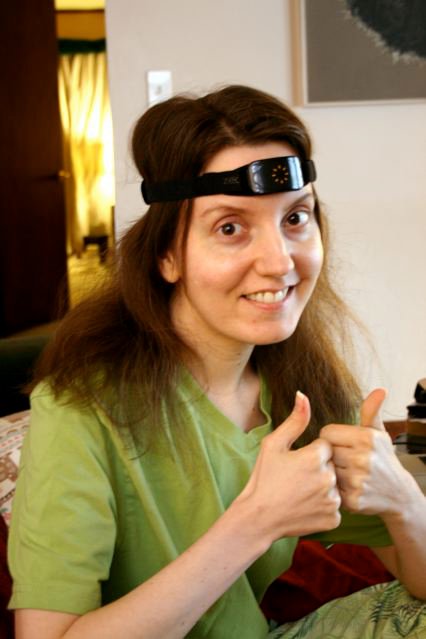
This thing tracks your brainwaves over the course of the night to show you what’s going on with your sleep. You wear the stylish wireless headband at right, and set an clock-radio-sized device next to your bed.

Now, I don’t sleep soundly on a good night. With the headband on (this picture brought comments from my friends on facebook that I looked like a guru, like I was going spelunking, or out to a rave), I got down about when I usually do, but didn’t stay there. I could feel the sensor on the headband working. It was giving me an pulsing sensation every few seconds, which, while not disconcerting, was slightly uncomfortable.

I have also felt the beams circling my skull while having an MRI done, so I already know I’m a freakshow when it comes to matters of the brain. I had Chimp put the headband on to see if he could feel it, but he wasn’t able to.

Anyhow, that sensation made it mightily difficult to drop off, which is always already a trial. And there were other problems as well.

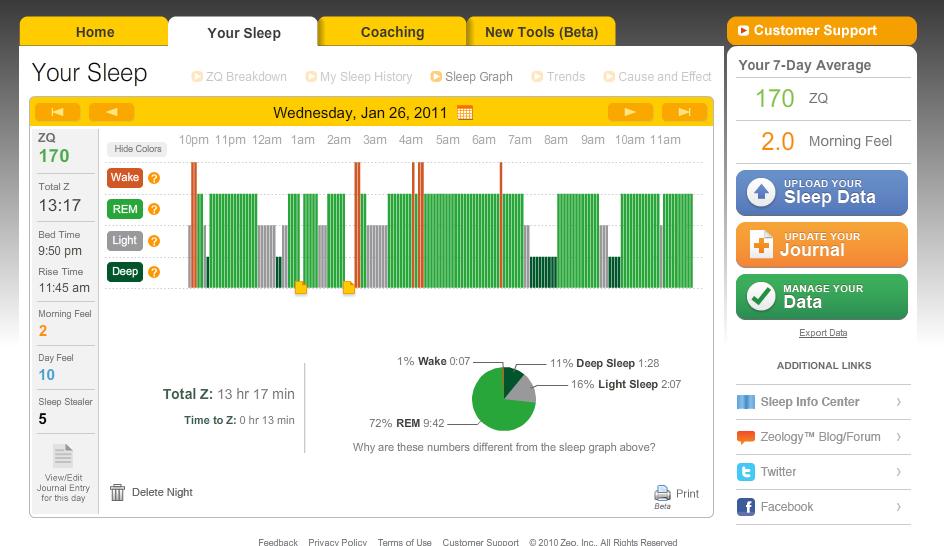
Within ten minutes of putting it on, before I came anywhere close to falling asleep, Zeo was telling me I was in REM sleep. I thought I fell asleep around midnight, which is about normal for me, and it turns out I was pretty close: Zeo said I was in deep sleep at midnight.

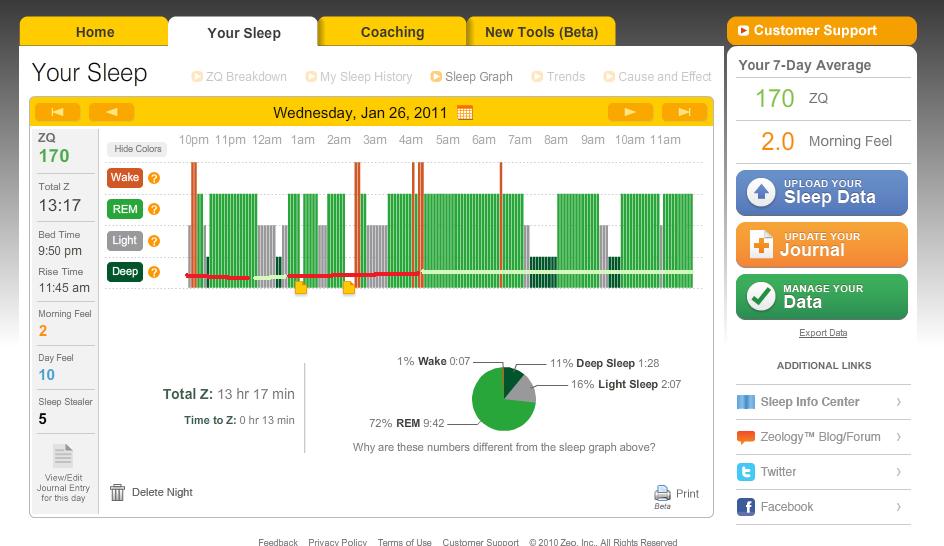
And it got weirder from there. So here’s the night’s sleep graph.

It looks like I was in REM sleep (green) all night, right? Seven hours of REM sleep? And I was awake only briefly (orange)? Nope. I realize some people will say, “Well, you don’t know if you’re asleep; people often think they slept less than they did.” However, I was looking straight at the thing as it declared I was in REM sleep. Here’s how much I actually slept; the red line is where I’m aware I was awake, green where I know I was asleep.

So it got that first stretch of sleep right, then told me I was in REM or deep sleep while I was awake, then that I was in a variety of stages of sleep when I actually was asleep.

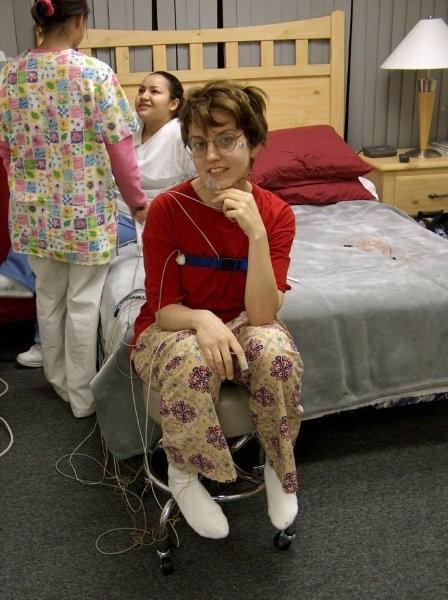
Sleep Study in the Poppy StateThe other thing that’s interesting about this is that I had a sleep study done in 2004, within the first six months I was ill. Here I am on that occasion, stylin’ and profilin’ with stuff glued to me. Interestingly, the night I was in the lab, I had zero REM sleep.

It’s been six years since then, and certainly some things could have changed, but I feel doubtful about my results here for that reason.

I knew in advance that this device might not work for me, truth be told. I read this terrific and hilarious review at Amazon from a lifetime insomniac, and knowing that it might not work for me, I was still interested in giving it a shot. It sounds, in retrospect, like I am having the same issues he had.

So I’m not going to wear it tonight; I have to get some better nights of sleep under my belt before giving it another shot. Chimp is going to give it a go tonight, though, and we’ll see whether his more normal brain (he has only garden-variety insomnia, not the shocking version I do) gets more coherent results.

Posted in ME/CFS | Tagged , | 10 Comments