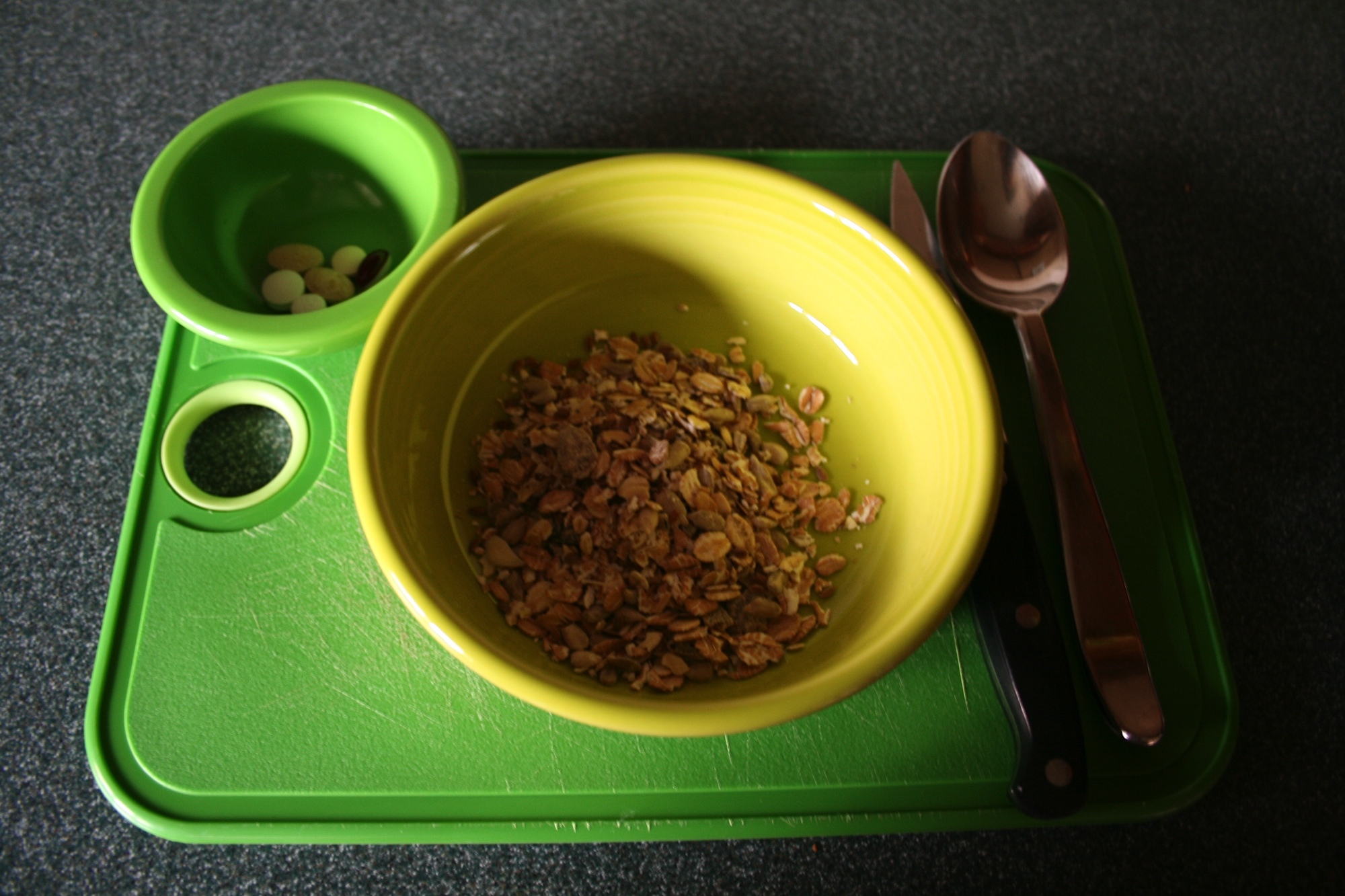
Starting the assembly of breakfast, my quotidian victory.
If you’re a healthy person, how many things do you think you do per day?
Your to-do list at work might have a half-dozen things on it, but I’m talking about more than that. Maybe you run a few errands after work and do some housework when you get home, and you think that brings it up to an even dozen?
What if I told you you do a thousand things per day?
I say that to demonstrate my perspective as someone with ME/CFS. The difference between what you can manage and what I can manage is enormous, and it’s likely that you and I see our possible energy expenditures in an entirely different way. Those thousand things include actions you never think of, things you’re hardly aware of – things that you would never think of as taking energy, because to you they take such a negligible amount. But they would would be enormous against my tiny supply.
And in comparison, how many things would you guess I do? Well, I’d say I’m up to a hundred now, maybe more depending on the day, but at my sickest, I’ve gotten down to as few as a dozen.
A dozen things a day is totally bedridden, unable to get out of bed and walk across the room. To get a bath, I had to be wheeled the twelve or fifteen feet from my bed to the bathtub. My computer sat on a table next to the bed, but my ability to use it was limited to reading about one email a day. No typing. No facebook. Most of my energy went into eating my meals, which were brought to me in bed by my mom on a tray, and to picking up my water glass and sipping from a straw when I was thirsty. Turning over from one side to the other counted as one of my dozen actions. I could only manage to change my clothes once every four days. I couldn’t stretch my muscles – the sort of thing you usually do a few times a day – because it ate too much energy, preventing me from having enough for other things I needed to do. My sense of humor disappeared, at least to my caretakers – I could barely speak, and I couldn’t afford to waste the few precious words I could manage per day on making jokes. I also had to consistently suppress the urge to laugh, because it too took too much out of me.
I spent more than a year like this, from Christmas of 2007 to the spring of 2009, and there are many, many ME/CFS patients in that state. These days, I do more things before breakfast than I was able to do in a week back then, and basically each of them are things I was completely unable to do then at all.
By illustration, a typical morning of late: On waking, I change into the clothes I set next to my pillow the night before, pull up my covers, making my bed lying in it, fold up my extra blanket, go across the room to pick up the decorative pillows and back to put them on the bed. I walk to the bathroom, wash my face, get out a towel and face cream, dry off, put the cream on, and put the towel and cream away. I fold my bath towels, which were drying overnight. From there, I go to the kitchen, get out a bowl, a spoon, measuring spoons, cutting board, the canister of muesli, my pills, a pear, a hot pad, the carton of soymilk, and a pre-measured syringe of B12. I put muesli and water in the bowl, sit at the table to cut up the pear, then place the bowl in the microwave and start it. I put the pear core the in trash, the utensils in the dishwasher, and sit down to wait for my breakfast to cook. I take the muesli out of the microwave, pour soymilk into it, put the soymilk away, and carry the muesli and my pills to my dayroom.
That, in case you weren’t counting, was 34 things. And that’s about a third of my energy expenditure for the day right there.
I can do a lot more now than I could a few years ago, but I still have to watch myself very carefully. But this, honestly, is a large part of why I manage to be happy, as sick as I am. When I was limited to a dozen things a day, my dream was simply to be able to read on the computer all day in order to fill my time, so I didn’t have to lie in bed doing nothing but staring at the same walls every day. Anything that I can do beyond that reading feels like gravy. Being able to walk to the bathroom, to heat up a meal, to have a little conversation, just to be able to get up and leave the room if I want to – all of this is a dream that I never thought would come true.
But while I’m doing better now, figuring what I can manage, and staying what is called “inside the envelope” is still a constant struggle. I mentioned above that there are things that a healthy person doesn’t even think of as taking energy that in my case would count toward my number of things. In terms of staying inside the envelope, it’s not just obvious physical activity I have to beware of.
Avoiding these other, less-obvious energy-drainers is key, and we’ve adapted my environment so as much as possible, I’m not burning what I don’t have to spare. But those adaptations are largely not available and even more, not understood in the outside world – even in, say, doctors’ offices – and that, on top of my energy level, keeps me inside the four walls of my house.
Some of the things that I have to beware of are:
“Minor” physical exertion – Staying upright, for most people, is just a normal part of their day. My heart won’t pump enough blood to allow me to, so I lie down about 98% of the time. If you have a conversation with me, you might notice a preternatural stillness, because to fidget, or to talk with my hands, takes energy. I read almost entirely online, because to hold a book and do the repetitive motion of turning pages is too much effort. For the same reason, I have to carefully watch how long I pet my cats. When I go to bed at night lying on my side, I prop myself with pillows fore and aft, so my body doesn’t have to use muscle power – and energy – to keep me in position.
Sound – There are several components to this. Normal sounds now seem about three times as loud as they actually are, so when someone new steps into our house and starts out at a normal conversational tone, before Chimp gets a chance to tell them to speak quietly, it sounds like they’re basically yelling at the top of their lungs. My brain does a poor job of blocking out extraneous noise, so a normal conversation in the next room, or the sound of kids playing outside, make my brain continually jump to attention and can wear me out very fast.
I also have an enormous music collection gathering dust, because the stimulation of music wears me out even faster than does conversation. I can listen to a song or two a day, on good days. For the same reason, audiobooks and podcasts, which are a life-saver for some ME/CFS patients, are so challenging as to be impossible for me, because with no visual cues, they require an enormous amount of processing power to understand – cognitive abilities that I just don’t have anymore. My tolerance for sound also depends somewhat on how I’m doing – if I’m having a good day, I can deal with more, and if I’m having a bad day much less. Some days the dishwasher going behind the kitchen door is no problem, and some days I have to put my earplugs in, or ask Chimp to run it after I go to bed.
Light – My photosensitivity has a couple dimensions too. Too much light flooding into my environment, like having the blinds of my dayroom more than halfway up, causes my eyes to sting and is tiring. Likewise, I have a terrible time with overhead lights – they feel very physically oppressive and sap my strength. I generally have to keep light sources behind me for the same reason, and fluorescents that obviously flicker are very bad news – I don’t get a headache; I just get tired.
Smells – I debate whether light or smells are the everyday thing that’s most problematic after sound. My sensitivity to both is amplified, so smells are much stronger to me than they seem to be to others. Light, generally, is at least adjustable – you can turn it off. There’s no turning smells off, so the only way for me to deal with them is to avoid them or get away from them. When I encounter any sort of scented product that I’m unaccustomed to, like body care products or household cleaners, it feels like the smell is repeatedly interrupting in my brain like noise does, and I can’t think straight as long as it’s present.
Physical pressure – I have closets full of treasured clothes, vintage and otherwise, that I never get to wear because I can no longer deal with the pressure of normal garments – they too are draining, because my body constantly uses energy sensing them, and because my body has to struggle against them to breathe. This, for those of you who’ve seen photos of me in the last five years, is why I’m always in pajama bottoms and a loose-fitting men’s v-neck t-shirt. The pajamas have to be knit, and soft, though, because woven is too binding, scratchy fabric causes the same sensing, and the elastic can’t be too close-fitting either. Thank goodness I don’t need a bra, because I can’t manage to wear one. I no longer wear contacts – only glasses – as having the lenses sitting on my eyes is a pressure problem. Wearing jewelry also falls under this heading – every month or two I get my wedding rings out, put them on and look at them a bit sadly.
Visual motion – The first time I noticed this really being an issue was relatively early on, when we were at a favorite restaurant in California that had high ceilings, with lights above the ceiling fans instead of below. The fans cast crazy whirling shadows all over the place, and I felt increasingly sick and then more and more worn out the longer I sat under them. Ceiling fans alone are now a problem for me, even on video. And video in general is a huge energy-eater, too. I can deal better with some things than others – something like a placid, quiet BBC program is more tolerable than anything with a lot of jump cuts, and I really have to beware anything flashy or blinky. I’ve never actually had a seizure, but things that flash make my brain feel very bad, very fast, and can be one of those hit-the-power-button-instead-of-trying-to-close-the-browser triggers.
Emotional stress – This is tough to even write about, because just thinking about the topics that cause me emotional stress causes emotional stress! The main trouble is that, seemingly because I don’t have enough energy to evaluate and handle stressful situations normally, my system tends to react to it the only way it thinks it has left – by juicing me into fight-or-flight mode with a surge of adrenaline. (Good luck on both the “fight” and “flight” aspects, body.) I know it thinks it’s helping me to survive, but the minuscule items it reacts to in this way are pretty ridiculous. Reading an article containing a political opinion contrary to mine? Adrenaline! New comment on something I wrote, and who knows, we haven’t read all of it yet and it might turn out to be negative? Adrenaline! Remembering a past stressful event? Adrenaline! It’s a non-optimal response, to say the least – and those surges of adrenaline are difficult for my body to clear. I can easily end up hot and weak with my arms shaking, ruined for a couple hours, or more. For this reason, I try to avoid stress and conflict as much as I can, for example by hiding friends with contrary political opinions on facebook.
These difficulties didn’t become part of my life all at once. I got sick, and then a little more sick, and then a little less, and then more and more. Because they’re all normal for me at this point – just how my life is – they’re sort of invisible to me. I wanted to write them out like this because I suspect that many of my well readers, those who don’t know me personally or haven’t spent time with someone like me, might not have a good sense of just what that middle F in our much-hated three-letter acronym really means.
All that above? That’s what “fatigue” consists of. Those are the constraints I live with that I have to both remember to stay within for my physical health and try to forget about for my mental health. It really makes the f-word sound like an insult when you see it all laid out like that, doesn’t it? It’s not fatigue. I and people like me are dealing with constant, debilitating exhaustion that affects every bodily sense, every decision, every moment of our day.
Fellow ME/CFS patients, I really want to hear from you here. Would you please take a few of your number of things, if you have them to spare, and tell me about some of your personal constraints?