(Lyrics here.)
One day about three years into my illness, when I was still well enough to be working but sick enough to be doing so from home, I met my departing boss – let’s call him Brad – for a farewell lunch.
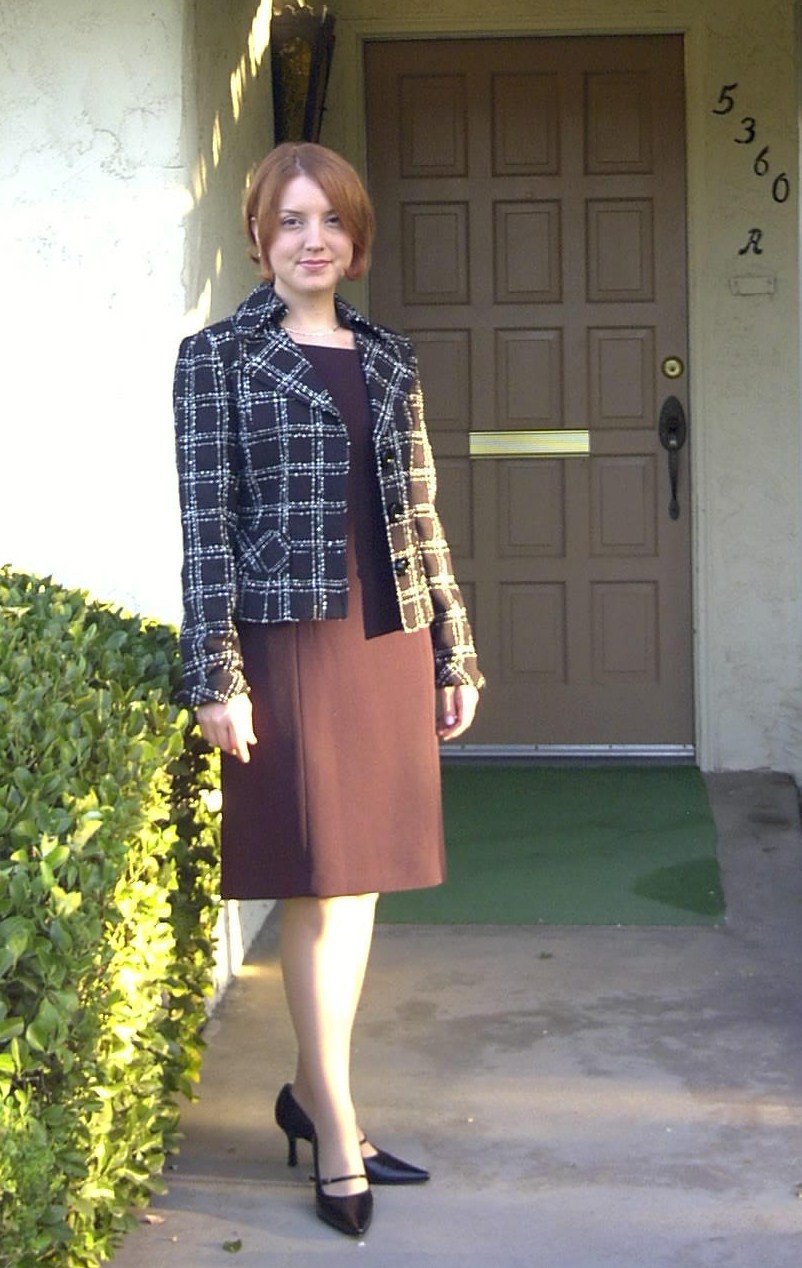
Chimp snapped this the day I went for my first interview at the marketing order. The Nanette Lepore jacket was a splurge and my first of a number of her designs. Ah, fashion. I miss you.
Not long after we moved to California in 2003, Brad snapped me up for a marketing analysis position at the California stone fruit marketing order, which he’d been hired to reshape. Serendipitiously, my resume – and a letter about me from the pen of the professor who’d been my food marketing advisor at Western Michigan, from where I’d just graduated – crossed his desk just as they’d been about to advertise the job.
Because of my unusual degree, I’d come into the job with some capabilities that the organization hadn’t previously had, and together with Brad and the rest of our marketing team, we’d brought the order a long way in a short time. Now, in the spring of 2007, he was leaving to go work for a fruit shipper.
I wasn’t feeling so hot that day. We’d made plans for the lunch a week or two earlier, and when the day arrived, I was feeling weak and woozy, and found myself dizzy walking into the restaurant in an all-too-familiar way. I knew I was overdoing it, but I felt obligated to go through with our plans, and I was then in the constant habit of overdoing it, honestly.
We sat across the table from each other, talking about our families, what we’d accomplished together, his plans for the company he was joining. And eventually I asked him, “Do you think I have a future in the ag business?”
Brad was kind enough to say, “You’re undoubtedly smart enough to do any job you’d be interested in.” He paused, and added, “As long as you get your illness under control, I think you’ll go far.”
When lunch was over and I left the restaurant, I was still fuming. Get my illness under control? As if it was some assigned project that I needed to stop procrastinating on. As if there was some obvious cure I had declined to take that would heal me. As if I hadn’t been pruning away all other aspects of my life, putting all my dwindling energy into holding onto that job. I knew Brad surely hadn’t meant to offend me, but I couldn’t help but be offended. I was giving my all to that job, and I felt like I was being told that the sacrifices I was making still weren’t enough. On the other hand, deep down, I knew being sick was holding me back.
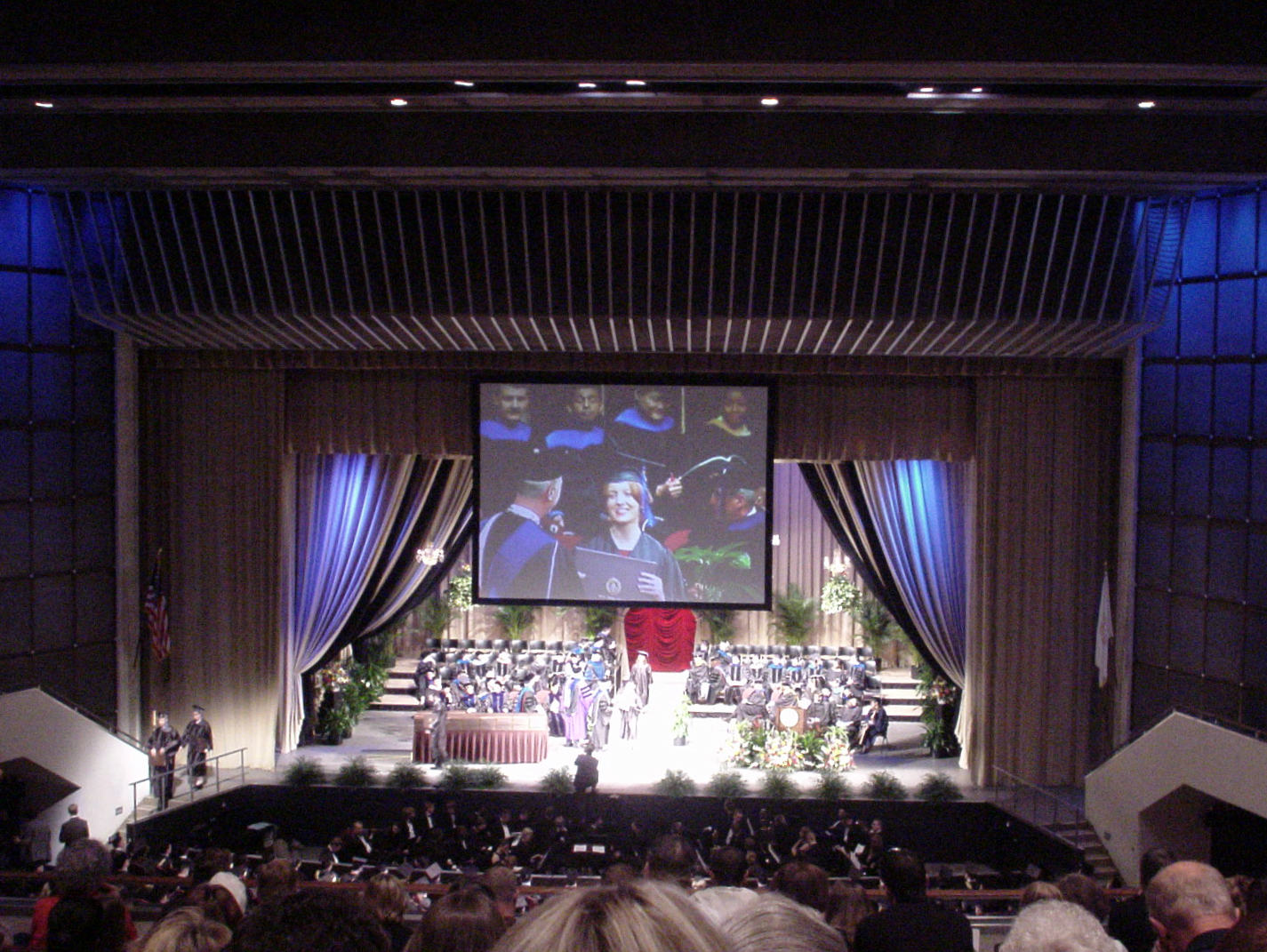
Six years of college for this moment. (For some reason drama degree credits don’t go very far when you switch to a marketing program.)
I thought back to 2003. I’d graduated from Western Michigan ten years after graduating from high school, having worked for five years of that time after leaving college at the end of my sophomore year. Around the time I graduated, Chimp’s department head said to him, referencing my ambition and my being in business instead of academia, “Are you prepared for her to make more money than you?” Chimp was fine with it, and I was certainly fine with it – he and I had gotten together in 1997, and up to 2003, one or the other of us had always been in school and the other working full-time. But no matter; I’d gotten a lot of knowledge out of my circuitous path, and had thought – why wouldn’t I? – that there was no hurry, as I still had a long working life in front of me.
Nope. One healthy year after I graduated, and then struck down.
Not long after starting my new job, Brad had wanted me to enroll in a year-long produce industry development course, but between my hiring date and when it began, I had already fallen ill. We decided I’d hold off and do it the next year, when I thought I’d be feeling better. But then the next year came, and the next, and I was still in no shape to undertake such a commitment.
By the time I had that lunch with Brad, not only had the disease done a number on my physical functioning, it was doing a real number on my self-confidence, too. It was bizarre to start to lose my confidence, as I had never thought about how dependent it was on my physical health. Dependent on my smarts, my abilities, my drive, sure. My physical health? That I just took for granted that it would continue to be there. But my health and my confidence were tied up together. As I could count on my body for less and less, the constant uncertainty of day-to-day life with ME/CFS made me increasingly protective of myself, and that protectiveness caused me to be more timid and less willing to take risks.
Timorousness had never previously been a problem for me, but now it felt like my initiative and boldness were evaporating. A colleague who’d met me during the first bad wave of ME/CFS I suffered later said, “When I met you, I just thought you were just really shy.” Shy was not something that I had ever remotely been described as. But being sick made me seem so.
And the longer I was sick, the more knock-on effects of this emerged at work. Where I’d previously been take-charge, I started letting others volunteer for projects I would have enjoyed to have as my own. Known for creativity and blue-sky thinking, I now kept quiet in meetings when I would have otherwise have spoken up if my suggestions might add to my workload and thus my energy deficit. I noticed that the everyday stress of the job – things like time pressure and minor conflicts – was growing harder and harder for my body to manage, and was leaving me increasingly wiped out. Worst of all, my cognitive function was deteriorating – tasks that’d once been automatic were now requiring unusual effort, and while others didn’t seem to notice, I nonetheless had wanted to hold on to every one of my IQ points.
I had also started to feel opportunities falling away from me. Brad’s departure meant his job came open, and my boss moved into it. I might have been a natural candidate for her job, had I been doing things like participating in the industry development course, and had I still been working at the office rather than at home. I probably technically had the abilities needed to grow into the job, but it was clear to everyone that I didn’t have the energy level, and I wasn’t asked to apply. Frankly, I was fine with that. Because of the physical difficulties and the personality changes, mostly I just wanted to be left alone to do my analysis and editing – because that I could still manage, and my Excel and Word files didn’t ask me to talk or to travel or even to sit up, which was becoming increasingly difficult.
Looming over me was the possibility that all the life pruning in the world might end up being insufficient, and I might eventually not be able to physically manage my job. After pushing myself to go to too many meetings in the fall of 2007, which caused a crash, and shortly after that the start of my famous insomnia, I had an autumn of sliding downhill, ended up bedridden by Christmas, and that put an end to my working life. I struggled through the production of one last HTML newsletter – what would usually have taken me an afternoon took me five days, struggling through it an hour at a time each day before collapsing – and turned my files over.
It wasn’t a difficult decision at that point; frankly it wasn’t a decision at all. The disease made it for me, and to finally let go of the job was somewhat of a relief. I had been trying so hard to hold on to it for so long, and my insistence on doing so had made me worse and worse. Maybe if I gave it up, I thought, that would be the thing that would help me turn the corner.
But on the other hand, I was 32 years old and I’d been working in the food business for a dozen years. I had started out in retail at Whole Foods because of my idealism, and had gotten from there to where I was by being a bit of a workaholic and a perfectionist. I loved the job I had in California – it was precisely what I’d been hoping to find when I went back to school. I worked as hard at what I did because I truly believed in what I was doing. My focus on doing good through the world of food was my animating purpose in life – I loved it so much that I felt lucky indeed that I could get paid for it – and an enormous part of my identity.
Now it was suddenly all gone. Now the major force in my life was not what I was doing, but what was being done to me by my illness – and I had to figure out who I was all over again.