Voting in Vivint Gives Back: Daily Vote Totals Graph

Just a real quick one here. A poster on Phoenix Rising has been keeping a tally of votes by day. So I asked her if she’d mind throwing together a graph comparing the pattern of daily votes for the charity I’m backing (in blue) and Conejo Valley Friendship Circle (in red). Here it is – click to enlarge.

Posted in Uncategorized | Tagged , , , , , | 5 Comments

Paying for Votes in Vivint Gives Back

So here we are again. I had hoped never to need to write another post about cheating in a charity contest.

When Vivint Gives Back started, several people asked me if I was going to be keeping an eye out for voting irregularities and compensated voting, given what’d happened during Chase Community Giving. I said I would, and if it happened, I’d write about it.

Yesterday, Sabrina Melanie posted a link on my blog’s facebook page to a post at SwagBucks Offer Zone, in which iRazoo credts were being offered in exchange for Vivint Gives Back votes. That led me over to the Phoenix Rising forum, where payments being offered in online currencies were being discussed.

The group offering the credits? A Chabad organization in Conejo, CA.

The organization is Conejo Valley Friendship Circle, which, like Conejo Jewish Day School, is part of Chabad of the ConejoFriendship Circle is a group that provides families that have special needs kids with support. Their main activity is supplying teenage mentors for those kids. The teenagers spend time with them, giving their families a bit of respite and providing the kids with friends outside their family. The Friendship Circle was founded in the Detroit area in 1994, and in West Bloomfield, Michigan, they have a special facility where the kids can come to practice life skills through roleplay. I absolutely love that – I wish I could visit and see it in action.

The VoteFive.com page as it appeared during Chase Community Giving. Click to enlarge.

Now, going back for a moment, for those of you who missed the Chase contest: Conejo Jewish Day School placed sixth in the 2011 Chase Community Giving contest. They won a total of $125,000. They were one of five schools – the VoteFive.com group – that ran up the leaderboard in the last few days. It’d been a pretty steady contest up to that point – not much change in where various charities were situated.

Of the other four VoteFive.com schools, Silverstein Hebrew Academy placed 3rd, winning $325,000 (after winning $500,000 in Kohl’s Cares the previous fall), Southern Connecticut Hebrew Academy placed 7th, winning $125,000, Hillel Academy of Milwaukee placed 9th, also winning $125,000, and Lubavitch Cheder of Oak Park, MI came in 13th and received $65,000.

These schools offered game currencies and also direct payments in exchange for votes – up to $0.28 apiece. Silverstein Hebrew Academy paid the most and also placed the highest.

So what’s going on in Vivint Gives Back?

First, there’s this spare-looking little website, VoteFriendship.com, which gives you instructions on how to vote in the contest. But what’s that tiny text under the instructions say? Ah, it reads: “Please note: To be awarded, the endorsment [sic] must follow the above steps in order.”

But what can we be awarded for voting for Friendship Circle? Well, take your pick :

You can get 43 iRazoo points. This offer turned up two places: Project Swag and SwagBucks Offer Zone (click to enlarge).

The remainder of these are cached links, because the offers are too hard to find on the regular pages. Click on the link above each image to be taken to the cached page. These cached links may not continue to work; that’s why I grabbed these screenshots. (Also, see how all of these say in the small print that you’re going to vote for SHA? Remember that in Chase, one of the VoteFive schools was Silverstein Hebrew Academy – but Silverstein isn’t even in this contest. I bet they reused the deal template from the Chase contest and forgot to change the small print.)

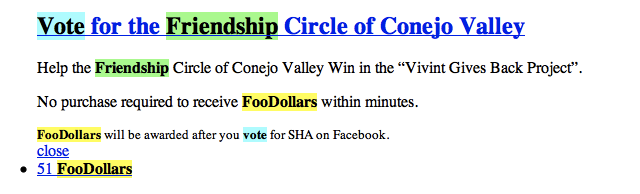
51 FooDollars:

56 FooDollars:

5 cash:

68,000 coins:

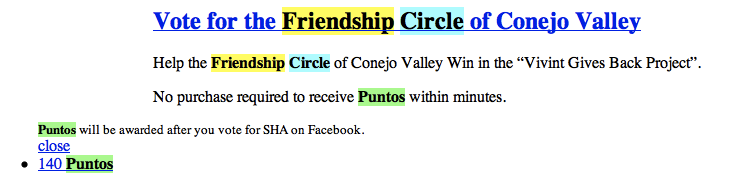
140 puntos:

Helen Watkinson was able to get some of the offers to connect to VoteFriendship.com. Here’s an example of one she found on gWallet:

First, here’s the offer (click to enlarge).

Clicking on that took her to the VoteFriendship.com site, like so:

And going through the steps brought her to the Friendship Circle page on Vivint Gives Back:

This is totally discouraging, right? Same basic thing as Chase, no recourse to do anything about it…or is there?

Early on in the Vivint contest, I asked if raffles and prize giveaways were permitted. Vivint said this: “Vivint does not condone or support the process of charities compensating voters for endorsing or voting for their charity. We feel that it is against the spirit of the competition and that the process should be avoided.” So they weren’t supported, implying that they were not disallowed, either. But they seem to have evolved their position since then.

A group called CHERUBS (Congenital Diaphragmatic Hernia Research, Awareness and Support) appears to have planned a raffle (click on See More on that page) and then had to cancel it because Vivint disallowed giveaways. The pertinent paragraph:

We are very sorry to have to report to you that Vivint has changed the contest rules and decided to *not* allow raffles or any type of exchange of goods for votes, including raffle tickets. They did this to even out the playing field a bit more and to encourage people to vote just because they believe in the causes. This is beyond our control and we have to abide by the rules.

Kudos to them. I’m sure it was really disappointing to have to call that off.

ME/CFS group May Twelfth (it’s ME/CFS awareness day, if you didn’t already know that) asked whether vote exchange is allowed in Vivint Gives Back. Vivint’s answer?

So there you have it. If raffles and vote trading aren’t allowed, is outright compensation allowed? It doesn’t seem like it would be, but I suppose we will have to allow Vivint to make the decision. I supplied this information to them, and received back a message that read, in part, “Thank you for this information.  I will begin looking into this right now.  Information like this helps us to successfully maintain the integrity of the Vivint Gives Back Project.”

Posted in Contests | Tagged , , , , , , , | 27 Comments

Thin Thighs in 35 Years

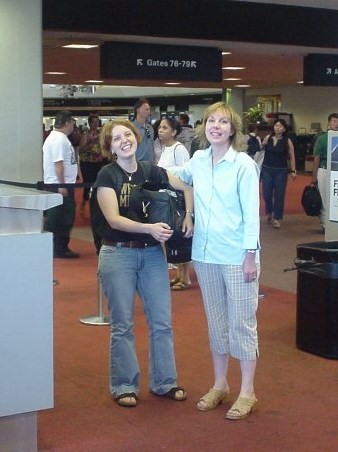
Annie, Janet, Sharon, me, and Susie. I’d chopped my hair off this spring to play Rosalind in _As You Like It_.

I always wanted to have great legs.

The picture at right is of my mom (center), her sisters, and me, in 1993. As you can see, my mom has great legs. Her three sisters have great legs. Their older brother probably has great legs too. (I’ve never thought to check.)

I, however, from adolescence on, was perpetually unhappy with mine – my thighs in particular. My mom’s were slender. Mine were not.
Mom and me on the way to California in August 2003. Mingus is sitting unhappily in that carrier I’m cradling. This was a running-20-miles-a-week figure for me.

Mostly with that as my motivation, I was from the late 80s to 2004 a yo-yo dieter, registering every weight from 117 lbs. to about 145 lbs. at least twice, and more often oscillating from the high 120s to the high 130s. It seemed like I’d gain a pound if I so much as looked at a brownie. I had to battle mightily to keep the scale steady. In 2002, I bought a treadmill, and that made it possible to consistently get the amount of exercise in I had to do to keep at the weight I wanted to be, which was the mid-120s.

No matter what the scale said, though, I was never happy with my legs. Even at my thinnest, I just didn’t like their proportion to the rest of my body. Shopping for pants was something I was only able to deal with infrequently and with a major emotional girding of the loins. (Sorry.) And swimsuits? Forget it. I favored grandmotherly skirted styles, and then boyshorts, when they came into fashion. I think it’s fair to say I had a complex about my thighs.

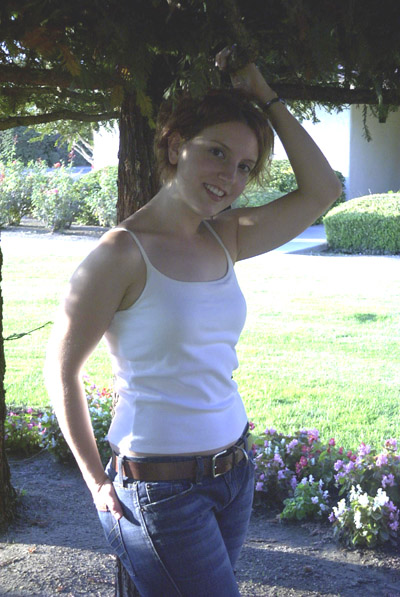
October 2003, out in front of our apartment in California. I weigh about 128 lbs. here. This is one of the last pictures I have of me well.

And then I got sick.

I had been running three to five miles a day to keep my weight under control, and I was immediately unable to exercise at all. But strangely, six months into the illness, without dieting or exercise, I’d dropped from 128 lbs. to 118 lbs. (Doesn’t that sound like a too-good-to-be-true fad diet plan? Get sick! Lose weight! No dieting or exercise!) 118 lbs., for me, was a running-thirty-miles-a-week-and-eating-nothing-but-carrots weight. I’d never lost weight without trying – and now it was falling off me.

I had to buy all new clothes. I was swimming in my pants, and all my shirts’ shoulder seams had begun to creep down my arms. I remember standing in a dressing room at Banana Republic, realizing that all the sizes I’d pulled from the racks were too big. I asked a salesperson to bring me smaller ones, and she remarked how lucky I was to have such a problem.

I started hearing that a lot. “Lucky you, I bet you can wear anything.” “Lucky you, you’re so skinny.” I didn’t feel lucky. The one upside of developing a 24-inch waist was that I was able to buy a lot of beautiful vintage clothing that nobody else could fit into. My pals at one retro emprorium even started putting everything my size that came in on a dedicated rack for me.

November 2004. Six months in, ten pounds down. Remember these jeans styled with a belt sander? Good times.

With the change in my figure, I suddenly had a window on an experience that was entirely new to me. When you’re an average size, nobody really notices or remarks upon your averageness. When you’re really skinny, you become an object of curiosity and comment, and there’s this whole set of assumptions that people make about you. People think you must not eat very much. That you must have amazing self-discipline. That you’re thin because you stick to a diet plan in a way that few people are able to. That you’re thin because you’re doing things “right.” And worst of all, that you’re somehow more virtuous and “better” than people who weigh more than you do. And none of those things were any truer of me than they had been before I became suddenly thin.

I realized that before I got so thin, I was guilty of believing every one of those things about thin people. Sometimes, when people would launch into the litany of my amazingness based on my body shape, I’d try to tell them I hadn’t always been so thin, that I was sick, that nobody could figure out what was wrong with me, that I couldn’t seem to keep any weight on, no matter what I ate, that I would take every pound back and more if I could be well again. It rarely registered – I once had somebody say, “I wish I could get sick and lose weight!” I pretty quickly stopped trying to explain myself, and just let what felt like ill-gotten compliments be heaped upon me.

May 2005: 116 lbs. These are the same pair of 7 for All Mankind A-pockets as in the October 2003 picture above. right. As you can see, at this point, I could pull them off without unzipping them.

So why did the weight fall off? I think there are a few possibilities. There are people who think ME/CFS has an enteroviral connection. I think that’s possible. I did get something that like food poisoning back in Chicago in 2004 and very shortly after that, the whole thing kicked into high gear.

I think that that, or some other mechanism, altered my gut microflora when I fell ill, reducing the efficiency of my body’s processing and absorption of calories, and that’s why I started losing weight, despite increasing my caloric intake. I guess beforehand my body must have been ruthlessly efficient in that respect. It always felt that way.

There was a point in the fall of 2007, when I was getting precipitously worse, when my system just did away with digestion entirely and started passing food through virtually unchanged (sorry). I began losing weight even faster and was quickly down to 107 lbs., a weight I’d last registered around age 11 or 12. My doctor at the time started me on betaine, which helped replace the stomach acid I wasn’t making, and later Dr. Cheney recommended I take pancreatic enzymes (PDF), because I wasn’t making those either. Both supplements helped stem further loss, so I think that indicates both things were, indeed, a problem.

The other strange thing that happened, which might have contributed to the loss, was that my attitude toward food totally changed. I had always really, really loved food – I mean, I loved it so much that I made it my career. I was the type of person who was always thinking of what I was going to eat next, and when I could eat it, and I definitely struggled with my appetite.

Before I fell ill, if there was food in front of me – like chips or bread at a restaurant – I couldn’t seem to not eat it. My always-slender mother could do that, and I never could understand how it was possible. But when I got sick, all of that appetite melted away in the strangest way. I stopped thinking about food so much. I could pass up a slice of cake, or push the chips away. I remember, years after I fell ill, watching Chimp’s and my wedding video. I recall seeing how much I was clearly enjoying attacking a piece of cake – and I hardly even recognized that person. I just didn’t care about food in the same way any longer. It was an enormous and strange personality change to experience. What did that? I still don’t understand it, but it seemed like something must have been different about my gut, my brain, or maybe both.

Taken by Chimp, June 2011.

Once I became truly bedridden at the end of 2007, my body changed still further. Unable to walk, my muscles really started wasting. I also lost my very defined waist, which had always been a point of pride. For a while after I became bedridden, I tried to keep my weight up, but eventually I realized I was replacing muscle weight with fat weight, and so I’ve let it fall as it will.

At this point, I weigh about 111 lbs. Even at my present weight, I could stand to lose some of the fat I’ve gained around my middle. I hope to do that if I ever get well enough to really walk again. And at right is the current state of my legs. They are quite thin from muscle atrophy – and because of this, I’ve learned something about what made those thighs that I hated for so many years look the way they were.

They weren’t fat – they were muscular.

Posted in ME/CFS | Tagged , , , , , | 29 Comments

My Weapons-Grade Insomnia, Part II

So…where were we? Ah, yes. Before the editorial expression of concern and the Chase debacle, we were talking about sleep.

Mingus (rear), Coltrane (left), and Bootsy Collins (right), way better at this than I.

For years and years now, I’ve been progressively increasing the number and amount of drugs I take for sleep. Frankly, the volume of pills I take for this is alarming – when I pile them up at the beginning of the night, it does rather look like I’m trying to do myself in. So when I say “I can’t sleep,” I don’t mean like “I need an occasional Ambien” or “It takes a bit longer than it does for most people.” I mean I cannot get a moment of rest without major pharmaceutical intervention. But I didn’t really know why this was the case until my most recent appointment with Dr. Cheney.

By the time my appointment rolled around this spring, I was at the maximum level of some of the things I was on, and some nights the whole regimen still wasn’t working. I had tried a couple new drugs and had not been able to tolerate them. This was part of why I moved my appointment to April from its usual spot in May – I seriously needed help figuring out what else might work. But let me back up a minute here.

When I was crashed for the second time in two months at the end of January this year (both times because of my sleep drugs failing), I asked Dr. Cheney what I could do to try to help myself bounce back faster. One of the things he suggested to me was that I could increase my inosine. I added some at night, instead of upping the morning dose, and found that it helped me sleep. So I shifted the first dose to the evening and the second to the early morning, at the same time I take my second round of things that help me sleep.

When I went to see Cheney in April, I asked him why inosine helped my insomnia. He explained that inosine produces uric acid, which scavenges peroxynitrite. Peroxynitrite, he told me, is produced in a cytokine storm in the brain, which, among other things, is a mechanism of sleep disturbance. Blocking that cytokine storm with inosine, then, helps me sleep.

This lead him into a further discussion of cytokine storms and what else counters them. Artesunate is an NF-kappa B inhibitor, and it sits at a choke point for a cytokine storm, so it should help with sleep as well. Low dose naltrexone, which I’m also on, can inhibit the cytokine synthesis of microglial cells, and encourages the body to produce its own opioids, both of which interfere with the cytokine storm.

So the fact that inosine and LDN, both of which I’d tried before my appointment and both of which helped me sleep, indicated to Dr. Cheney that a significant part of my insomnia was caused by a cytokine storm in the central nervous system. The cytokines in the central nervous system, he then explained, come from those previously mentioned microglial cells.

After that, Dr. Cheney explained what else he thought was behind my insomnia. He said that if we did a MRSI (magnetic resonance spectroscopy) scan of the brain, it would indicate what is called a lactate peak in the lateral ventricles of the brain, which should not be present, but commonly is in ME/CFS.

Interestingly, Dr. Cheney said a lactate peak in the brain is associated with both feelings of anxiety and sleep disturbances (I can’t currently find a cite for the latter). I asked him if this could help to explain that feeling I had in Chicago in 2004 that something terrible was about to happen. He remembered that being part of my case and said indeed, a feeling of doom would be consistent with that physiological symptom.

Because my body is running in a low-energy state because of loss of mitochondrial function, he went on to say, it isn’t producing enough ATP for my brain. So, to compensate, he said, my brain is partially running on adrenaline – and it’s rather difficult to sleep when one’s brain is running on adrenaline.

And if there’s a problem with mitochondria, he told us, there will inevitably be a problem with magnesium depletion. So supplementing magnesium should help with sleep, and a number of other problems as well. (And it did, as I mentioned in the previous insomnia entry.)

So: Inosine, LDN, and magnesium have all helped. I’m not sure whether the artesunate at night is helping, but it doesn’t seem to hurt. The other thing that I discovered that helps – and this happened entirely by accident – is calcium. One night when I overdid it on the betaine (the stomach acid supplement), I chewed some Tums to knock the acid down, and found it was easier to sleep. I know magnesium improves the absorption of calcium, so perhaps taking the two together (they’re often paired in mineral supplements) is having a synergistic effect. Also, over the course of the night, every time I realize I’m awake, I dose myself with several sprays of ionic magnesium, and that definitely seems to help me fall back to sleep more quickly.

At this point my sleep cocktail includes a half-dozen prescription drugs – but none of them are traditional sleeping pills. This is because Ambien and the rest of the “z-drugs” are closely related to benzodiazapines, and they do the same thing to me that the benzos do: give me screaming anxiety.

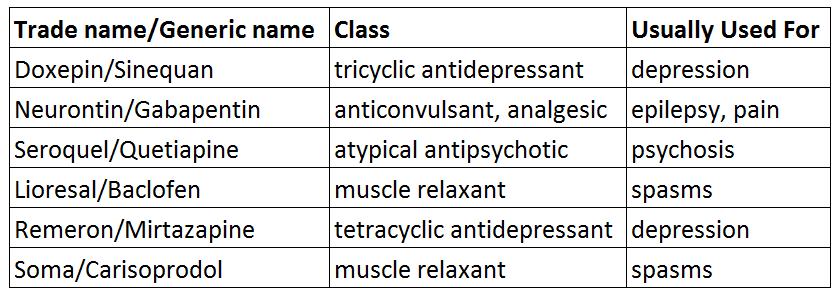
I’m at the maximum dosage of the last two, Soma and Remeron. I tolerate all of these pretty well, though I take a beta-blocker because the Seroquel tends to run my heart rate up. I take all of these with that previously mentioned betaine, because I produce little stomach acid of my own and I won’t absorb the pills without it.

And here are the things I’ve tried and abandoned for various reasons. For the purposes of this table, nervousness < anxiety < agitation. There’s a whole lot of not fun here.

If the current wheelbarrow full of pills stops working, we have Phenergan, an anti-nausea medication, on deck to try.

I’m very grateful there are as many pharmaceuticals to try as there are, and that Dr. Cheney knows the world of supplements so well. Without any sleep drugs, I would have died in 2008. Because I have them, and Dr. Cheney’s expertise, I’m not only still here, I’ve actually improved since first seeing him in 2009. Back then, my dream was just being able to read on the computer for the whole day. Now I can even type a little most days. Sure, I’m not where I wish I could be, but I never thought I would get back even as far as I have. I’m happy to have it, for however long it lasts.

May 2013 update: I’ve added two supplements to my nightly regimen this year – P5P and Sam-e. I’m taking them in the wee hours and they’re helping me stay asleep for the second half of the night.

Posted in ME/CFS | Tagged , , | 33 Comments

I’m Concerned About the Editorial Expression of Concern

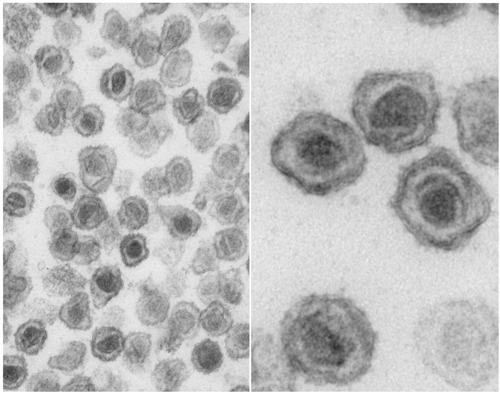
XMRV by electron microscopy, captured by the WPI.

A serious hat tip here to Danny Ze-Dog, whose scientific savvy was enormously helpful in putting this entry together.

So since the triumph that was the October 2009 announcement of Lombardi, et al., which found XMRV in people with ME/CFS, human gammaretroviruses have seemed to become increasingly controversial. Since the original study, performed with the cooperation of the Whittemore Peterson Institute, the Cleveland Clinic, and the National Cancer Institute, and published in the journal Science, there have been a number of negative studies that did not find XMRV. Many of them are what are termed 0/0 studies – they found no XMRV in ME/CFS patients or in healthy controls.

Recently, Science published another 0/0 paper, Knox et al. and along with that, they issued an editorial expression of concern. The Whittemore Peterson Institute responded with a press release and a letter from Judy Mikovits delineating why they believe the expression of concern is premature. I’d strongly suggest you read Dr. Mikovits’s letter, and do so slowly and carefully. I know it’s tough going in spots, but even if you’re not scientifically inclined, you’ll pick up enough of her points that you’ll see where she’s heading, and my attempts to summarize her words would not be as effective as her words themselves are.

One important part of Dr. Mikovits’s points that I will repeat here is that Papotka et al. claim in their study – the one published in the most recent issue of Science – that the contamination that seemed like XMRV was from the 22Rv1 cell line. This cell line has never been present in the WPI lab, nor have any of the other cell lines said to be contaminated with XMRV.

Anyway, that said, I acknowledge that it looks bad to have so many negative studies pile up. But unfortunately, they all have the same problem – they are not true replication studies. This is what the scientific process demands – replicating the conditions of the experiment exactly in order to judge whether the conclusions are accurate. A rough approximation is not good enough, especially in a difficult new line of research like the one the original study represents. The study that came closest to replication – Lo, Alter et al. – did not find XMRV, but did find another human gammaretrovirus in the same family, which they termed the P variant (XMRV being the X variant).

So what are the differences in the studies that have been done following on Lombardi, et al.? Here’s a set of tables (PDF download), again authored by Judy Mikovits, noting only some the differences in some of the studies conducted thus far. This is another thing to read slowly and carefully. Remember that the original paper Judy Mikovits is among the authors for is Lombardi et al. (the first study listed in a column), and the most recent paper published by Science is Knox, Levy et al. (the study in the rightmost column).

One of the problems with Knox, Levy et al., the 0/0 study in the rightmost column that also appears in the current issue of Science is this: In their serology testing, they used two testing methods on one patient. Those two methods were ELISA and Western Blot. This patient was positive by Western Blot, showing antibody reactivity to two viral proteins, and negative with ELISA…then all additional patients were tested only with ELISA, not Western Blot. Why?

Returning to the larger problem: There are a couple overarching questions that the critics of Lombardi, et al. have not been able to answer, to my knowledge, that I think are the most important. If XMRV is only a lab contaminant, why do patients have detectable antibodies to it? They would not produce antibodies to a lab contaminant. And why, given identical handling for the blood samples, is there such a difference in the percentage of ME/CFS patients and controls found to have XMRV? Lombardi, et al. found 3.7% of controls with XMRV and initially 67% of ME/CFS patients. Lo, Alter et al. also found a far lower percentage of controls carrying the P variant (6.8%) than they did the ME/CFS patients (86.5%).

It’s not all 0/0 papers – there are other studies that have found XMRV as well. Ila Singh found it in 4% of the prostate cancers she tested, but when she did her most recent study, she switched to a new assay, tested blood, and came up with a 0/0 study (which is also listed in that set of tables from the WPI). Fischer et al. found it in respiratory secretions – in 2.3% of healthy people and 9.9% of the immunocompromised.

All that said, XMRV is, admittedly, extraordinarily difficult to detect. Part of the difficulty of detecting it is that it has very low copy numbers in peripheral blood, unlike HIV, which basically teems there. Instead, XMRV is hanging out in reservoirs, like macrophages, or the prostate. There was a study last year in which they infected macaques with XMRV and subsequently detected only transient viremia in two out of three animals (that means they could only find the virus they knew was there some of the time in some of the animals). This thing is a sneaky bugger.

So what do I think should happen? I disagree with the decision to issue an editorial expression of concern. I believe the scientific process should be allowed to run its course. If true replication studies show no evidence of XMRV, well, we have to consider a new direction. But we’re not there yet, and there was no need for Science to attempt to steer things that way with strong-arm tactics.

Why are we not there yet? Because of the lack of replication, at this point, most patients are awaiting the results of further research. There is more to come from the WPI later this year. There is rumored to be additional positive work from others in the pipeline that has not made it to publication yet because of being stymied by the number of negative studies released.

Additionally, there’s the Lipkin study, which is supposed to wrap up by the end of the year. This study will use a new round of blood draws from doctors specializing in ME/CFS from several different cities, and have the analysis done at three different labs: the WPI, FDA/National Institutes of Health, and the Centers for Disease Control. It’s certainly not expected to be a perfect study, but testing the same samples at separate labs should help advance things some.

But what we need is true replication, and then, if that indicates that MLV-related viruses, the family that XMRV belongs to, are present, varying the experiments one element at a time. That’s the only way to truly move forward.

I mean, hell, even I did an XMRV study. I used baking soda and vinegar to make a volcano, and I didn’t find any evidence of XMRV. So it must be laboratory contamination.

Posted in ME/CFS | Tagged , , , , , , , | 2 Comments

Cheating in Chase Community Giving: The End?

This is part of a series on compensation for votes in Chase Community Giving. Here are Part IPart IIPart III, and Part IV.

I know I’m like a dog worrying a bone with this thing. Knowing when to stop has never been my forte.

So last week, I posted four entries about the Chase contest between Wednesday and Friday.

By Friday afternoon, I had another entry ready – Part V – that linked VoteFive.com directly to one of the schools in the contest.

I basically had my finger on the post button, having sent the draft to Chimp to look over, when he came into my dayroom and asked me to hold off on posting it. He wanted me to do consult with a lawyer – or at least do some reading – before publishing something so explosive.

At that point, it was close of business before the holiday weekend. I was frustrated with his caution, because I wanted to strike while the iron was hot and while I was still getting massive traffic. I knew that he was right, though. Who wants to get sued, really?

So I started reading about the pleasant topic of defamation law.

Because some of the religious figures involved would fit in the category of “limited-purpose public figures” under Pennsylvania defamation law, they’d have to show I was acting with actual malice (which is a legal definition, not merely disliking someone’s actions) in order to make any claim. Additionally, in defamation law, truth is a defense. And I certainly believe I’ve uncovered the truth here.

I decided many people would be away from the internet over the holiday weekend anyway, so I decided to sit on the post until Tuesday, because I still had some research I wanted to do. By Tuesday, I was well into a second phase of the research harvesting openly-available social networking information, and wanted to finish it before I published anything. I realized that publishing that post I’d written on Friday might impinge upon my ability to do further work, because things that I needed might be pulled from the web.

By Wednesday night (which was last night), I’d done some heavy lifting in Excel to finish my work (Excel was the majority of my working day before I became disabled, and I daresay I’m a bit of a whiz). I started with 5000 records, which, via a PivotTable of interrelations, yielded about 30 names to check out on facebook. A dozen of them proved to be important.

And at that point, I believed I’d identified the rabbi who’d organized the whole thing and also believed I knew with whom he’d worked to do it. I’d also been able to connect two more of the five schools to the effort, for three total.

But the more I knew, strangely, the less I wanted to post it. The bigger things got, and the more the number of people I saw were involved increased, the more I felt like I was seriously risking my neck. Chimp had suggested that I reach out to a reporter who covers charities and another who covers business and consumer affairs. So I’ve done just that, sending along my published entries and some of the additional work I’d done. The story would practically write itself.

I’m waiting to hear back. If there’s no interest in writing a story about it, will I publish the additional research? I’m not sure. I think I have an airtight case. But I know even an airtight case comes with a risk to me.

In the meantime, I’ve sent all the new evidence to Chase, and of course, heard nothing in return. Tomorrow, Chimp is going to send a packet via certified mail with all the stuff I’ve emailed to them.

I think, honestly, that part of the reason I’ve found myself unable to charge ahead with naming names is that I’ve spent a week getting to know these people through the internet. And while I deeply resent what they’ve done, it’s far more difficult to put their names in pixels than it is to be angry about the almost faceless injustice of the compensation offers.

I wish I thought that publishing what I know would result in less cheating in similar contests in the future. But I think that it’ll mostly just give those involved an object lesson in how to cheat less detectably.

Posted in Chase Community GIving, Contests | Tagged , , , , , , | 10 Comments

Facebook Page: Investigate Chase Giving Cheating Now!

There’s now a facebook page for anyone outraged by the Chase Community Giving situation. Join us and let your voice be heard if you believe the only fair contest is one in which charities compete on their merits, and not their money!

Posted in Chase Community GIving, Contests | Tagged , , , , , | 13 Comments

Chase Cheating IV: Chase Giving Doesn’t Care About Cheating

Here are Part IPart II, and Part III. This is Part IV. There’s a The End? post too.

So everything you’ve seen in the last three posts I sent to Chase Community Giving. And this is what I received in response:

Jocelyn,
We are fully aware of this situation and to-date we have not found evidence that this activity is a result of actions taken by the charity.
Thank you for participating in Chase Community Giving!

So I replied:

So what you’re saying is that paying directly for votes is okay if you can’t prove the charity itself is doing it? Have you looked at the management of InvisionCA? Do any of them sit on the boards of any of the participating schools?

What about Hillel giving away a camcorder in return for votes? Or SCHA giving away iPad2s in return for votes? Both of those came directly from the schools.

What about the part of the rules that states “whose primary purpose is to advance a religious denomination, expand membership or encourage conversion, or whose programs and services are limited (in an exclusionary way) to serving those of a specific religious denomination or faith while excluding others solely because of their religious beliefs;”

They sent this back:

We cannot punish or disqualify participants based on allegations. Furthermore, the charities that you’re concerned with were of the many educational institutions we reviewed and determined met our eligibility requirements. 

And I said:

I would still appreciate an answer on how the giveaways I sent you relate to the rules.

****
That was at 12:46 p.m. EDT. Each of their replies took about fifteen minutes. It’s now 3:45 p.m. and I haven’t heard back from them. I don’t expect I will.

And I don’t know why I should have been at all surprised at their nonchalance at charities using money to make more money.

They are a freakin’ bank.

Posted in Chase Community GIving, Contests | Tagged , , , , , | 44 Comments

Chase Cheating III: Compensation/Giveaways for Votes

Andrea Whittemore wanted me to clarify that I don’t speak for the Whittemore Peterson Institute in this matter. So: I don’t speak for the WPI in this matter. I am just a lone crank with both a severely overdeveloped sense of justice and the inability to sit up for more than a few minutes.

I wrote this post because I believe that people – especially a group of people who have worked as hard as we all have recently, mortgaging our scant energy to get this done – deserve to know the truth about what they’re working toward. It turned out (at least to date) that we were working honestly to win a contest that could be won dishonestly.

Here are Part IPart II and Part IV. There’s a The End? post too.

The evidence continues to pour in, even though the contest is over. Yesterday, WPI said on facebook that there was supposed to be an announcement forthcoming about Chase’s investigation in the matter. As of now, there hasn’t been an announcement as far as I know, and WPI finished the contest in 12th place, after being as high as 6th. So while we’re waiting…

After my first post yesterday, people started finding all sorts of things.

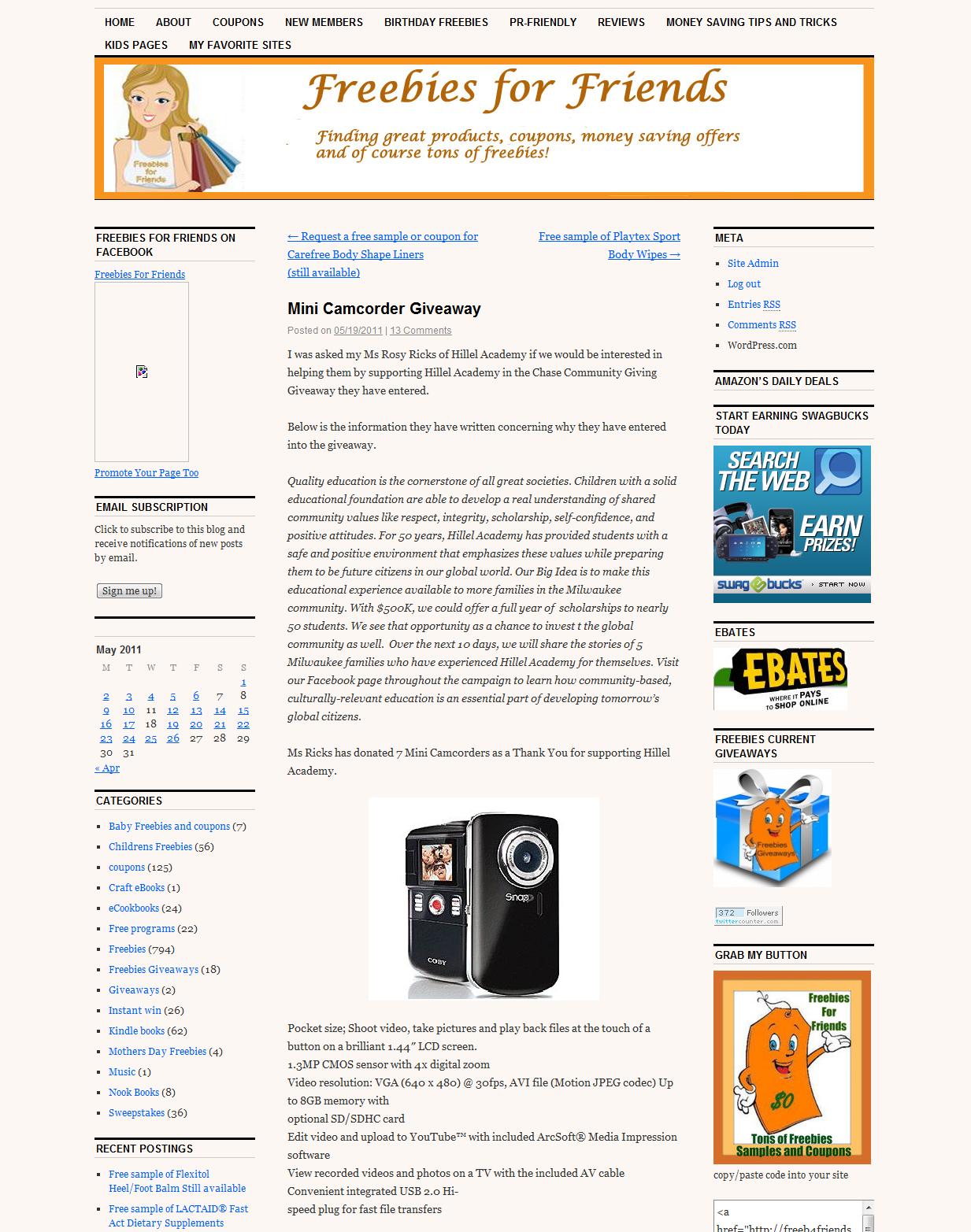
First, Jane commented and pointed us toward this camcorder giveaway for the Hillel Academy in Milwaukee. Here’s a screenshot:

(The rest of the page is behind this cut.) So this camcorder offer is part of how a group that has 247 likers on facebook can net 11,285 votes. (WPI, which, you will remember, I am not speaking for, has 4084 likers today and got 9019 votes.)

Jane also turned up a contest for students at Southern Connecticut Hebrew Academy to win Apple prizes for soliciting votes. I think this is less problematic. Motivating teenagers to do something like this is no mean feat.

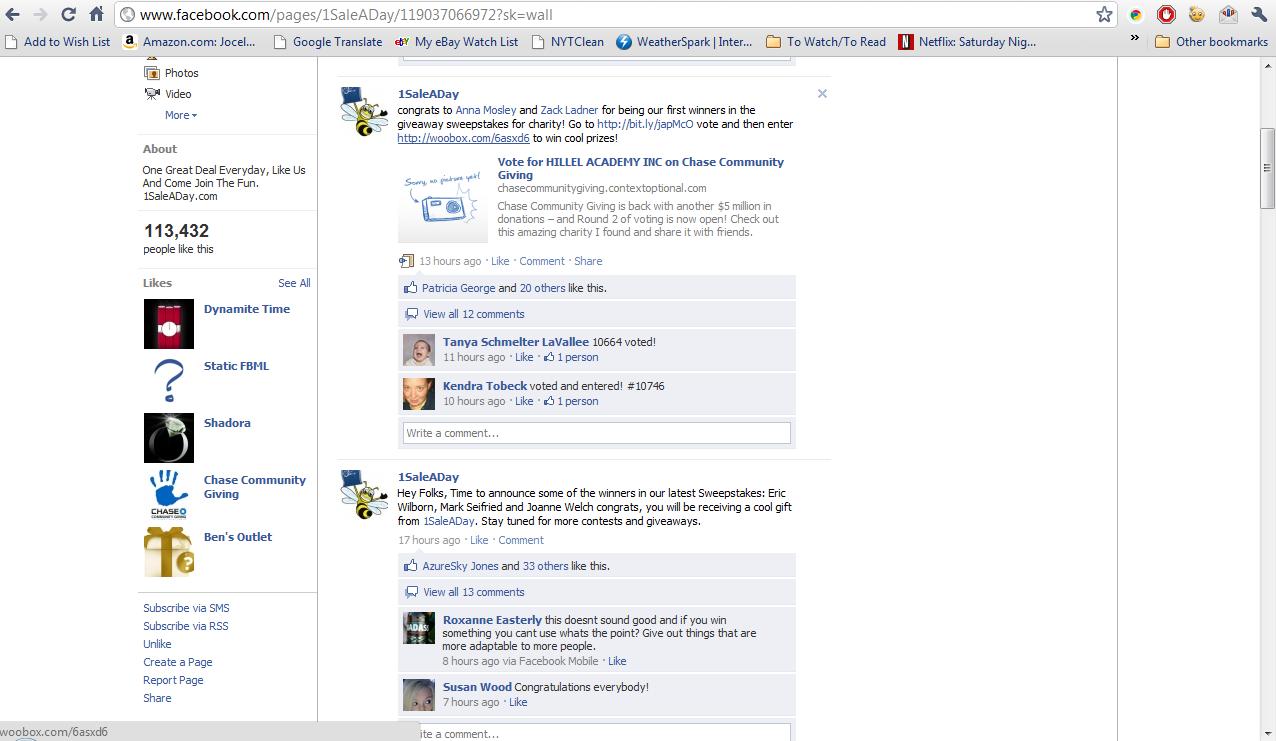
Then, this morning, someone on the WPI page (if it was you, please comment; I can’t seem to find the thread now) pointed out this sweepstakes offer on the 1saleaday facebook app which went to woobox, but unfortunately, once I got there, the link no longer worked.

But back to yesterday. Jean Maskuli did the real heavy lifting of the day yesterday. First, she found that the Sonia & Max Silverstein Academy was offering entries in a contest for iPad2s in exchange for votes. (To find this (at least until it disappears), type Silverstein Hebrew Academy iPad2 into the facebook search box and press the magnifying glass. Then, in the left column, click “Posts by Everyone.”)

Note that Dovid Ezagui is the director of Silverstein Hebrew Academy (here’s their contact page, and here’s a screenshot of that page). The fact that Chumy and Dovid share the email address mentioned in the top post (ChumyandDovid@aol.com) makes me think that they are possibly married.

But the big news last night was that Jean Maskuli turned up an offer on the facebook app EasyCash! that offered actual money in return for votes, as I mentioned in my previous post. We knew there had to be something like this somewhere, because of all the people I noted in my first post, who posted on the charities’ pages asking where their WeeMee gold points, SwagBucks, and facebook credits were. Here’s the offer Jean found, which goes to VoteforGood.info (the redemption site) and then takes you to the Silverstein Hebrew Academy’s Chase Community Giving page:

Then Jenime found a different set of EasyCash! offers.

Here are the pages that Jenime found EasyCash! links that go to. These are the five schools you saw on VoteFive.com.

Then Jenime shared with me that she tried out one of the EasyCash! offers to be sure that it actually worked, and that it credited her with $0.21 for her vote. The Silverstein Hebrew Academy offer Jean found was for $0.28 per vote, which would mean that if SHA had paid the maximum for every single one of its 20,421 votes (which I’m sure it didn’t), it would only have paid $5717.88 in vote fees. That’s a pretty good investment to win $325,000.

Then the app prompted Jenime to write on her wall, so she did. 😀

(Jennifer/Jenime is donating the $1.21 she made (and more) to the Whittemore Peterson Institute.)

Even before I saw the first EasyCash! offer, I knew there had to be a site out there somewhere handling the redemption. One of my favorite projects I worked on at the California Tree Fruit Agreement was a promotion called Tasty Tunes, in which consumers got free iTunes credits for buying both CA stone fruit and bagged salad. It was the first time anybody’d ever attempted such a project in the produce business, and solving the redemption problem was the promotion’s biggest issue. So I knew there had to be something pretty sophisticated out there – something far more sophisticated than a school could manage on its own. And once Jean and Jenime found these offers, we had our answer: VoteforGood.info.

And guess what? It’s no longer there. Neither is VoteFive.com. That was quick.

So is this cheating? It seems “unsportsmanlike” to me, but Chase has said nothing about the final rankings changing.

Yesterday, WPI (for which I do not speak) said that Chase was going to make an announcement “today or tomorrow” about some of this. But as I said above, no announcement has been forthcoming as yet.

This is a major black eye to Chase Community Giving, in my mind. I’m not going to be able to get anywhere near the support if WPI ever enters this contest again. And I, personally, will not want to go to the effort, unless Chase makes that promised announcement about their investigation and it changes the outcome.

Or if somebody wants to chip in $0.30 per vote for us.

Posted in Chase Community GIving, Contests | Tagged , , , , , , | 58 Comments

Chase Cheating Part II: Vote for Schools and promote anti-bullying

Here are Part I , Part III and Part IV of this. There’s a The End? post too.

Jean Maskuli worked some serious internet magic and found this for us.

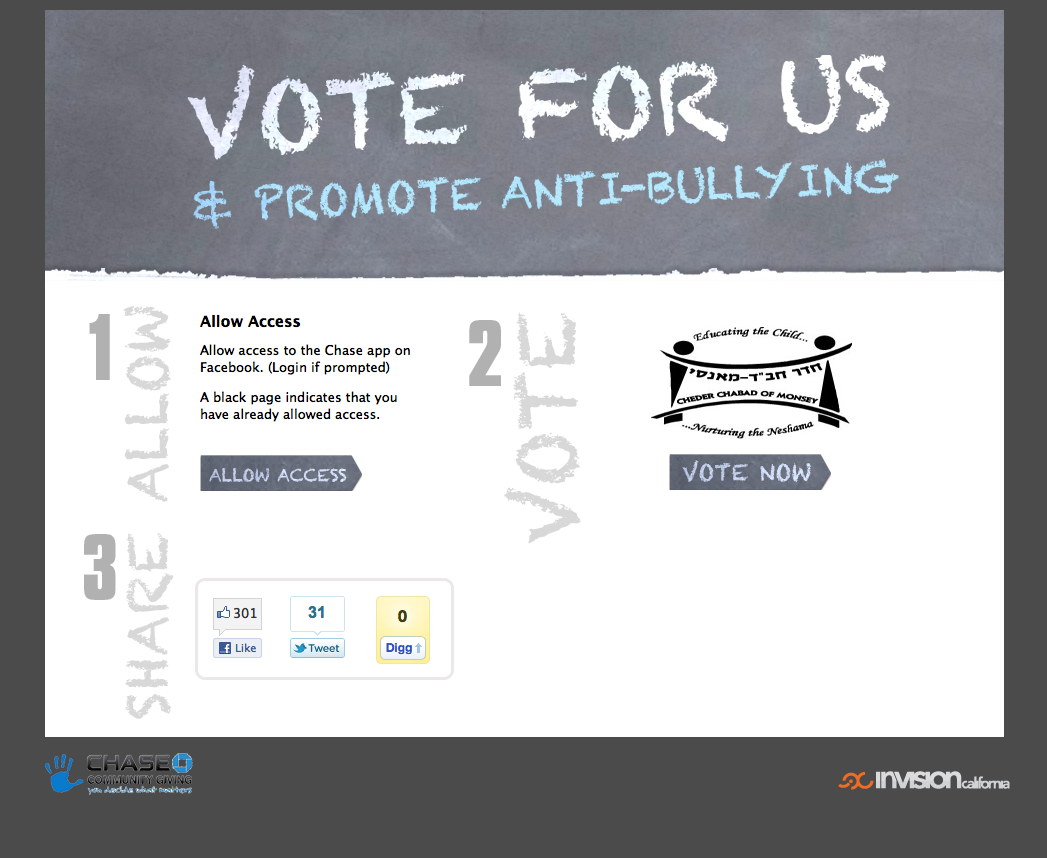
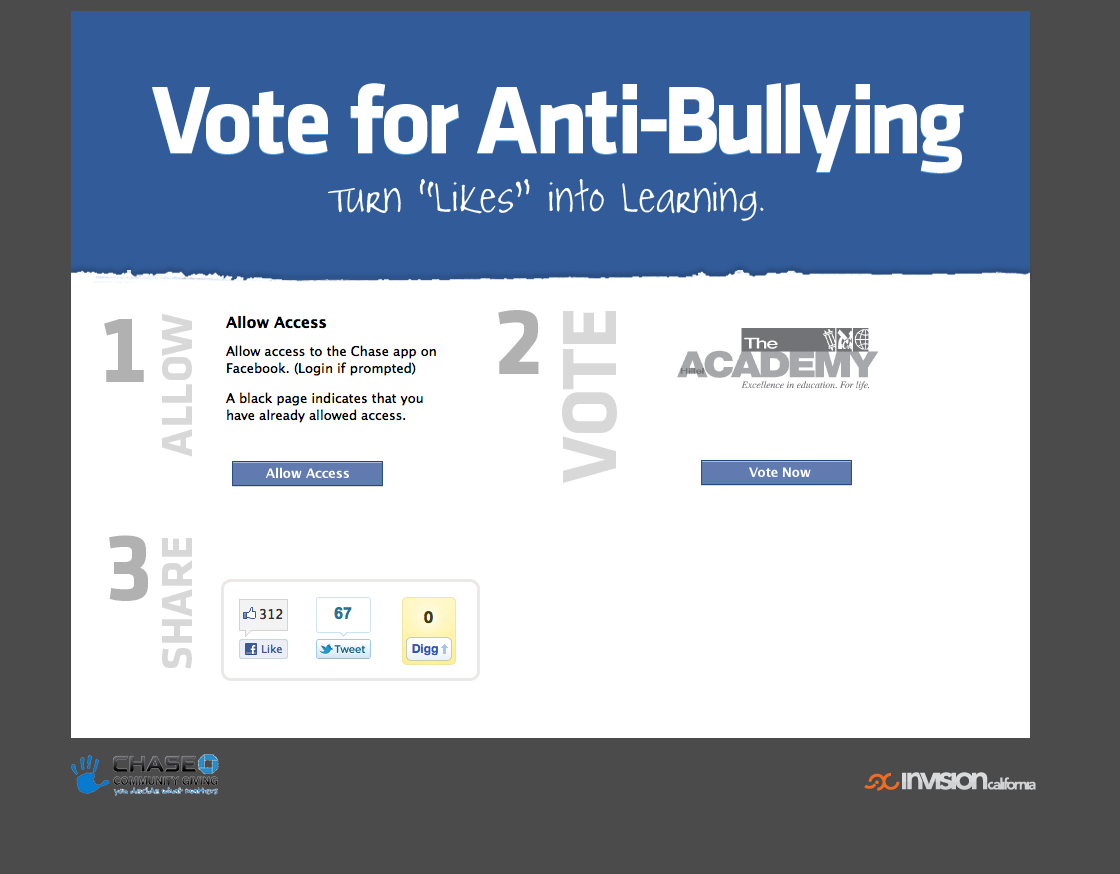
You can go to the EasyCash! app on facebook – the address is http://apps.facebook.com/easycash-usd/?page=offers. At that location, you will see the below, which I’ve screencapped in case it disappears. You are offered money to “Vote for Schools and promote anti-bullying.”

When you click on that offer that says “Vote for schools and Promote anti-bullying,” you will be taken to this page: http://www.voteforgood.info/?uid=44358251 which looks like this (look familiar? Yes, it’s the same color scheme as VoteFive.com):

 When you click on the “VOTE NOW” link, you are taken to the SHA Chase Community Giving page, like so:

And I assume that the back end then knows that you’ve voted and gives you your credits. I found this page where people said they’d completed the offer and it was credited.

So there you have it. There are undoubtedly other offers across the web that come to the voteforgood.info back end. That’s how they’re offering SwagBucks, WeeMee gold points, facebook credits, etc.

I’m sending this to Chase right now. And it means I was right about the back end:

Posted in Chase Community GIving, Contests | Tagged , , , , , , | 18 Comments