…a little better all the time…

I know it’s not much composition-wise, but these are peas I picked myself.

Memorial Day weekend is my sickiversary. Eight years today.

Things are looking up, though – I think I’m doing better now than any point since the end of 2007. Among the indications of improvement:

  • I’ve been playing Words With Friends for a couple months now. This requires more cognitive power than I had for a long time – between word-making and strategy, it would make my brain hurt and make me very tired very quickly. But now it seems to be easier, and it’s really enjoyable to have another way to interact with some of my friends.
  • I’ve felt well enough to have short visits with friends who’ve come through town. Five separate people have stopped by in the last six months for anywhere from an hour to overnight, and while it’s always been a little wearing, I’ve dealt with it without a major downturn.
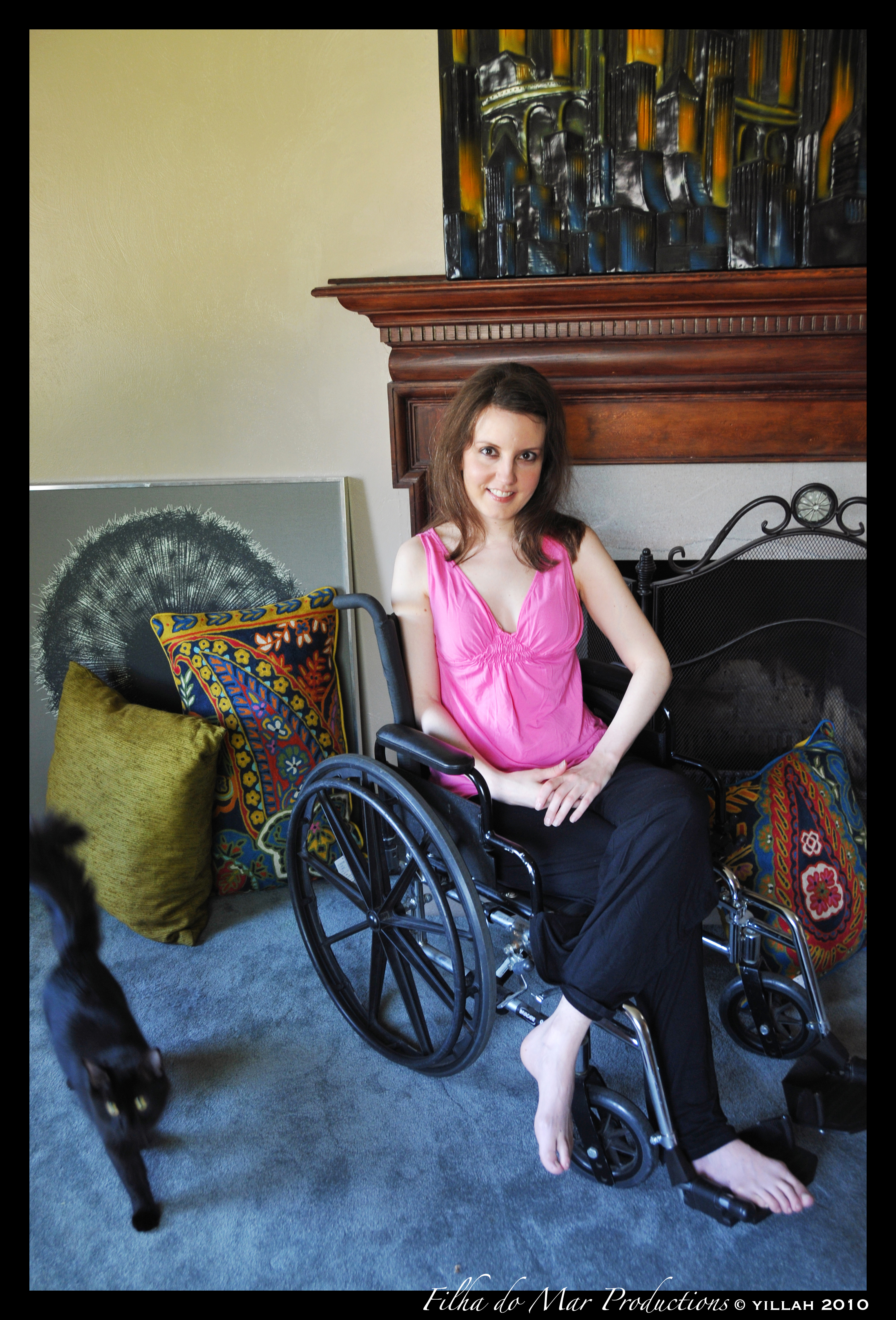
  • I’m walking better. For a long time, my muscle wasting was such that I got around with a sort of tottery gate – it felt more like using stilts, swinging from one point to another than actually walking. But now my gait is edging more toward normal, and I find I can negotiate stepping up or down without having to grab onto something and control myself using my arms. I would also swear that my calf muscles are looking a bit more developed. Nowhere near normal, mind you, but not quite as skeletal as they are in the last pic in this entry.
  • I seem to have more arm strength. This has been an issue since early on – I had already lost a lot of upper body strength before I was more than moderately ill. It’s easier for me to lift and maneuver objects lately. No Olympic records here, either – I’m talking about things like handling a watering can, or getting a large bowl out of a cupboard – but it’s enough that it makes a real difference in what I can do.
  • I’m able to get up more times during the day, and I’m able to stay up for longer when I do get up. I still have to watch it, but I don’t find the blood settling into my legs in 30 seconds like it used to – instead, I find myself getting a little faint instead of feeling the characteristic pain in my legs that the blood settling there produces.
  • A couple months ago, I started to make my own breakfast. This either involves measuring out muesli, sitting down to cut up dried fruit, and remaining sitting up while the whole thing gets nuked for a few minutes, then getting out the soymilk and pouring some in, or getting out a cutting board and knife, washing and chopping fresh fruit, pouring a bowl of cereal and putting some soymilk into a little pitcher and carrying everything out to my dayroom. Sometimes I realize I’ve forgotten my pills and I have to go back to the other end of the kitchen to fetch them. This might not sound like much to a healthy person, but for the last few years, it might as well have been a marathon.
  • Likewise, I’ve started a fair number of recipes for Chimp. This involves 1. gathering ingredients, 2. gathering implements 3. chopping, mixing, etc. Sometimes I only get to 1. or 2. before I have to stop, but I have actually made cornbread all the way through once, and on separate occasions I’ve left him with biscuits, flatbread, or cookies to roll or portion out and bake. Just today, I helped him fine-tune a big batch of pesto from the parsley that overwintered in our garden.
  • This spring, I’ve expanded my deck railing garden quite a bit, and I’ve been able to do more of its care. I’ve loosened and mixed dirt with a spade, filled pots, planted seeds, mixed up extremely stinky fish fertilizer (I know, I know, I’m a vegetarian; I plead that the smell of standard fertilizer is one of those things that made me feel sick even before I became ill. But as Chimp puts it, “I don’t think they harmed the fish; clearly by the smell of this stuff they just made them poop in a bottle”), watered (including managing lifting a watering can above my waist sometimes), and pinched things back. Last summer all I could do was go out and look at things, and do a bit of pinching.
  • The big development garden-wise is that I’ve begun to be able to manage to get out to the raised beds and the bed along our deck out in the yard. It means I have to go down some small steps and walk about 20 feet total, I think. We have four raised beds – or I should say, we’re about to have six, because Chimp has built two more. Out there, I’ve watered, harvested lettuce, cut down the overwintered parsley that was starting to go to seed, and picked snap peas.
  • The other big development is that I’ve finally seen all the upstairs rooms in person. I had made it up the stairs a few times previously – a couple of those times because Chimp had forgotten to turn off his alarm before he left the house – but up until recently, I hadn’t seen our guest room or the upstairs bathroom in the flesh. But now I have. It’s surprising how different they look than the pictures. Unfortunately now I want to redo the upstairs bathroom more than ever. By the time we get the budget together, 80s smoked glass and brass-toned shower doors will probably come back in. Sigh. There are parts of the basement I still haven’t seen, though, so I have the excitement of the laundry room to look forward to.

I don’t know what to attribute all of this to – is it the lingering effects of the short course of GcMAF, the continued Cheney Protocol, sustained good sleep, or just my body mysteriously turning things in the right direction? I can’t really say, but I’m grateful for every bit of it. I still spend about 98% of my time lying down, so I wouldn’t call myself “housebound” rather than “bedridden” yet, and I try not to ever assume that wherever I am, that I’m going to see sustained improvement from that point. But it is wonderful to have capabilities now that I haven’t had for a long time.

Posted in ME/CFS | Tagged , , , , , | 45 Comments

A Crash Course in Healthcare

I’ve written before about the series of events that ended in me falling ill, but one thing I haven’t told you about is the transition after that – the transition from being a healthy person to being a chronicially ill person, and the things I had to learn along the way.

So let’s begin this way: Once upon a time, I was really, really healthy – right up until I wasn’t.

When I fell ill in 2004, I’d never been sick with more than just your average cold or flu. Because of this, when my alarming symptoms started popping up, I had no idea what to do about them. I went to my gyno – my only doctor – who quickly gave me the brush-off because my symptoms didn’t seem to have anything to do with my reproductive organs. I thought it was her job to point me in the right direction, but she obviously didn’t think so. Eventually I found a GP near our house, and she started running tests, and then began sending me on referrals.

As I started to make the rounds of doctors, it never occurred to me that I might be dealing with the beginning of a chronic illness, not only because I’d always been healthy, but because my personality had long been particularly tied up with my devotion to healthy living. I’d been a vegetarian since my teens, had been following a whole-foods diet for many years, and was up religiously most days of the week before dawn to strap on my sneakers and run a few miles. Now as my health started falling apart, more than one person who watched me dragging myself through my days puzzled over the strangeness of it, saying something to the effect of, “This shouldn’t be happening to you, of all people!” I certainly agreed with them, but it didn’t change the fact that it was.

My symptoms were so weird, so sudden, and so dramatic that I thought there must be a simple explanation. I expected I would go to see some doctors, we would do some tests, the cause would be found, I would be given the proper treatment, I would undergo it, it would be effective, and I would go back to being healthy. That was the only scheme of interaction with medicine I really had for myself, despite the fact that I was married to someone with a chronic illness. (When we said our wedding vows in 2001, I thought I already knew who was going to be the sickness and who the health!)

One day a few months into my illness, Chimp and I sat in the office of my endocrinologist, waiting to hear the results of the round of testing he’d done. In our first meeting with him, based on the prominent pain I was having radiating down the front of my neck on either side of my windpipe, he theorized I was suffering from subacute thyroiditis. He seemed very confident that that was the source of the trouble. It made perfect sense, as I had just about every classic symptom – and he said if it was that, it was likely to go away on its own. Now, opening my chart to the test results, he looked over his glasses at me.

“Based on the testing we did, I’m sorry to say that I have no endocrinological explanation for your symptoms.”

Well, consider the other shoe dropped. Subacute thyroiditis had seemed like a sure thing. Now I was thrust back into uncertainty and the steadily increasing possibility that whatever I had would not be an easy fix. As I counted the duration of the tiredness from days to weeks, and then weeks to months, as more and more test results came back with nothing obviously amiss, I found myself thrust into a new experience: Learning to be an ill person.

It might sound ridiculous to say that you have to learn how to be ill, but you do.

There are all sorts of things I had never had to do or know before I started my intimate encounter with the healthcare system. Having been well all my life, there had been no need to know them. But once you’re sick, there are certain things that are useful to learn in order to be sick successfully. And by being sick successfully I don’t mean getting well, but learning to both manage and deal with your interactions with the health care system.

Among the things that I found I had to know or do:

  • Figure out the meaning behind all the boxes your doctor checked on the lab slip. In the process, scare yourself to death reading about illnesses associated with each test.
  • For fasting blood tests, become adept at the calculus of how long you can go without food as compared to how long the lines are likely to be at the phlebotomy lab.
  • Find out which labs have places to let you lie down for the draw so you don’t have to sit up for the test and then lie down involuntarily when they stick you.
  • Decipher the printouts that give your results, which will inevitably have developed hieroglyphic characters through some combination of multiple faxings and copyings.
  • Finagle short-notice appointments when a new symptom pops up, as if it helps. Learning the office staff’s names and sending treats at the holidays aids in this.
  • Become an expert at “new patient” forms, with the exception of always missing the back of one page that doesn’t seem like it should have a back side.
  • Request charts be forwarded all over creation, and always call before your appointment to be sure they arrived, because there is an unobserved black hole in 50% of medical offices.
  • Because any worrying symptom will inevitably occur on a Friday at 5:05 p.m. before a holiday weekend, when that happens, have the on-call doctor paged. That’s what having a doctor on-call is for. Really.
  • Write down your questions in advance, because the minute you’re engaged in conversation, the brain fog will suddenly descend to zero visibility.
  • Cultivate the skill of staring at waiting room fish tanks…enough that you begin to wonder whether you’re entertaining the fish just as much as they are you.
  • Avoid touching anything in the waiting room. Sick people sit there, you know.
  • Condense your tale of woe enough that you can get it all out before the doctor tunes out and starts talking over you.
  • Realize that when you encounter Dr. Asshole (and if you are sick for any length of time, you will meet Dr. Asshole, probably more than once, and unfortunately said physician will not be helpfully labeled on his or her coat as such), that you do not have to stay her patient, because there are plenty of Dr. Non-Assholes out there.

Besides all that day-to-day stuff, the thing that surprised me the most to learn was how different medicine is than how it seems from the outside. I had never seeen so many doctors in such quick succession, and besides a couple of dermatologists, I’d never really seen a specialist before.

Doctors have to know thousands of things, and as talented as they are, they are hampered by the limits of the human mind; they can’t possibly stay up to date on all the developments in every ailment. The more garden-variety your thing is (and the more concrete it is, symptoms- and testing-wise) the easier a time you’ll have getting it diagnosed. On the other hand, if your thing is not a common thing that doesn’t have a straightforward test, the more likely it is that you won’t quickly get the help you need.

Specialists, I found out to my dismay, are not the sleuthing Dr. Houses of the popular imagination. They know a set of things in more depth than a GP, but in daily practice, they have, let’s say, half a dozen or so things they focus on treating and which they know a great deal about. But if your thing is not one of those half-dozen things, they don’t generally say, “Yes, let’s dig in here; I’m perfectly happy to spend my limited time investigating something that’s out of my depth.” Nope. You’re basically bounced back out on the street.

When none of my test results came back abnormal and I was still exhausted months later, I finally did get officially diagnosed (my GP had said “CFS” aloud by four months, and formally diagnosed me after six). But I didn’t know how to find a specialist in my illness, and I didn’t even know what specialty my illness fit into. But that turned out to be a trick question, because ME/CFS doesn’t really have a home among the specialties. I’ve found that people specializing in it are a scattershot bunch: rheumatology, endocrinology, and plain old internal medicine, mostly. And there’s a bit of circular reasoning in play here: When you have a thing that doesn’t fit into any of the specialties, it doesn’t get the kind of respect it deserves, sadly, because it doesn’t belong to any of the specialties, and you’re basically SOL.

As I started reading about the illness it was becoming increasingly clear that I had, it also became increasingly clear that there was no known cause, and no known cure – only “management,” which is sort of a euphemism for “You’re superficially being ‘treated,’ but in truth we’ll be of no actual help to you; you’ll either get better or you won’t on your own, and the best you’ll get from us is sympathy.”

If I’d found myself in a medical system that had a place for me, or that took my diagnosis seriously, or anything like a test, a treatment, or at the very least some useful advice as to how not to make myself worse, I might not have had to learn all of the above. And if I hadn’t had to engage in that exercise in futility, I wonder how much different my outcome to now – or the outcome of any of the millions of people diagnosed before or after me, continuing right up to the present moment – would have been.

Posted in Life Before, ME/CFS | Tagged , , , , | 13 Comments

Fear Itself

I have two major phobias that I’ve had as long as I can remember: A rational one (as phobias go, at least) and an irrational one.

I have a fair number of minor ones, too, but I’m going to keep those to myself for now, lest one of you force me into a body of water I can’t see the bottom of and thrust a pill I’ve never taken before into my hands while serving me food that may have meat in it.

Oops.

Anyway, the rational one is of needles. Isn’t that a handy thing to be afraid of for someone with a chronic illness? The irrational one – well, it’s weird. When I was a toddler, old enough to be in a walker, and was scooting around the living room one day, my mother realized that I was chewing something. I shouldn’t have been chewing. She fished around in my mouth, found a piece of plant matter, and realized (this being the 70s, and this thus being the standard-issue house plant) I was standing next to a philodendron, which I’d apparently mistaken for an acceptable snack. I guess I had those vegetarian tendencies from the beginning.

She called the poison control number, and they told her that I would be okay, but that she should make sure I didn’t eat any more philodendron. This, again, being the 70s, she had been trying to raise me without using the word “no” to scold me, and this was the first time in my life she stressed to tiny me that something was dangerous and that I must not do it.

The next time we were out in the garden, she called me to her. Between the two of us was a weed, an enormous weed, with enormous leaves. She beckoned. I stood my ground. She beckoned some more. I didn’t move. Not realizing what the problem was, eventually, she picked me up and carried me bodily past the enormous weed with enormous leaves. As soon as she did, I started to scream, and ever since then, I’ve had a fear of plants with big leaves. I’m afraid that if I get too close to them, that they’ll wrap themselves around me, drag me into their clutches, and eat me.

I know plants don’t eat people. I told you it was irrational.

So, basically, walking through a (to others) beautiful field of sunflowers waving in the summer breeze (ack, they’re coming for me!) or finding myself suddenly face to face with a paulownia tomentosa is my greatest fear.

Other examples of how this has affected my life: In high school, I always took the long way to the bus stop, because the shortcut through the woods was lined with paulownia. When I started shopping for my own groceries, I steered a wide berth around the collard greens in the produce department because even big leaves with the stalks cut off were too scary to approach. Later, an apartment complex Chimp and I lived in had bear’s breeches everywhere, and when we came to check the place out, the idea of having to run the gauntlet of those plants every day was very nearly a deal-breaker for me. And since I know you’re about to ask, no, I have never seen the musical or the film version of Little Shop of Horrors, and I have no desire to.

I was feeling particularly brave and not a little self-deprecating during this 2000 visit to an Australian botanical garden.

The upside of this phobia, I suppose, is that it’s saved me a lot of money on tropical rainforest vacations.

As for the needle phobia, well, that one’s pretty normal, but mine’s especially bad. I used to think it was just because it hurts, even though I know it doesn’t hurt that much. What it’s really about, I’ve realized over time, is about having to give up control over my body temporarily and let somebody hurt me. I know it’s going to hurt, and anticipating that makes it incredibly difficult for me to override that basic fight-or-flight response and lie there while somebody sticks me.

The earliest I remember my needle phobia being a big problem for me was age 11. When I was a baby, I’d gotten my one-year MMR vaccination just a few days shy of my first birthday. Ten years later, that tiny oversight meant I was technically out of compliance with the schedule and needed a booster. Finding that out and having to get the shot was traumatic. The only thing that got me over the hump in that case was that if I didn’t get the booster, I couldn’t go to summer camp.

I managed to avoid needles almost entirely from that point to about age 20, when my doctor ordered bloodwork at a routine physical. I couldn’t figure out how I was going to get through it, and in talking about it with my mom, she suggested that I visualize something comforting and peaceful, like a litter of kittens playing in the barn on our family’s farm in Indiana. Kittens! Genius. For a major ailurophile like me, nothing’s more relaxing than watching a bunch of kittens play, and adding in the family’s homeplace would make it even better, I thought.

The day I’d decided on for the test, I arrived at the Kaiser lab and discovered that instead of individual exam rooms, it was a big open-plan place. And worse yet, as I walked in, several people were in the midst of getting draws. This was ten kinds of bad news, because my phobia was so bad at that point that I couldn’t bear to see tubes or syringes, much less needles or anything associated with the process – at all. I was already starting to feel a bit dizzy when the phlebotomist who was holding my lab slip tried to guide me to one of the chairs with a wide arm.

“Oh no,” I said to her. “I have to lie down. I might pass out or throw up.”

So I was steered to a chaise in the center of the enormous lab.

“Kittens.” I thought to myself. “Kittens kittens kittens.”

I heard her sit down next to me as I looked the other way. I closed my eyes. “I have a pretty bad needle phobia. My mom told me to think about kittens.”

“Kittens?” she asked, as I heard her pulling the gloves on.

“Kittens. Because it would help me relax.”

“Well, whatever works for you.” She slipped the tourniquet around my arm and secured it, then tapped at my skin.

“Kittens. Kittens kittens,” I murmured under my breath. Now she was swabbing the inside of my elbow with an alcohol wipe.

“Kittens kittens kittens,” I said quietly. “Kittens in the sunshine in the barn. Happy kittens. Kittens kittens. Lots of kittens. Stripey kittens.  Fuzzy kittens.” Despite the mental imagery, the unseen rustling noises at my right were causing me to tense up all over.

The phlebotomist pulled my arm toward her and moved into position. I tried to resist the urge to wiggle away, and settled for leaning as far away from my arm as I could, trying to will myself to forget it was part of my body.

“Kittens!” I squeaked from between gritted teeth as I felt her come toward me. I winced and braced myself. She pushed the needle into my arm.

“KITTENS KITTENS KITTENS! HAPPY KITTENS RUNNING AND PLAYING AND JUMPING AND….KITTENS KITTENS KITTENS KITTENS KITTENS KITTENS KITTENS KiiiiiiiiiiiiiiiiiiIIIIIIIIIITTeeeeeeeeeeeeeeeeEEEEEEEENS!”

She withdrew the needle and pressed a cotton pad against my arm. “Okay, we’re done. Hold that.”

Despite my attempts at bravery, I was crying now. “Kittens kittens kittens,” I sobbed. “Kittens.”

With tears streaming down my face, I opened my eyes as she taped down the cotton. “Kiiiittens. Kiiiitteeeeeeeens,” I keened, the adrenaline draining from my body.

And that was when I looked up…and realized that everyone in the place was staring straight at me.

Posted in Life Before | Tagged , , , , , | 38 Comments

The Post-Appointment Post, 2012

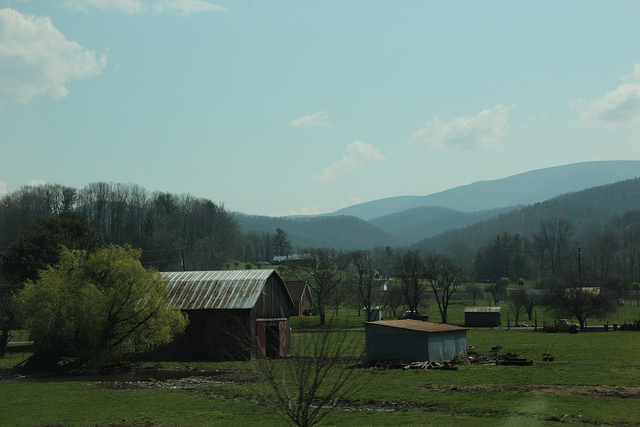
A North Carolinian view, taken by my mom during the trip.

I’ve been away from the blog because of my annual appointment with Dr. Cheney on March 20th. First I was trying to rest up to get ready for it, then I was trying to recover from it. This was the fourth year I’ve gone to see him, and we’ve pretty well got the trip down to a routine now. We left on Sunday, did the drive to Charleston that day, then the second half through to Asheville on Monday, to make it as easy as possible for me. My appointment was on Tuesday, and we drove home on Wednesday.

Unfortunately, my body picked the week before the trip to develop only my second cold in the course of my nearly eight-year illness. The last one was in 2005. Chimp had had it first, and we’d been not kissing each other for a couple weeks, until he seemed to be on the mend but just carrying around a lingering dry cough. At that point we decided he probably wasn’t contagious. Well, wrong. A week before we left, my throat started to hurt. And not only did I get a cold, in the process, the cold somehow found a way to kick back up that cytokine storm that I had spent five months trying to get rid of, bringing back everybody’s favorite: The feverish feeling. So I was already feeling extra crappy before we even got going.

This trip is always hard, and I always seem to forget how hard it is. I suppose this is a good thing, that I forget about it after I recover from the exertion, but it’s not terribly fun to be surprised anew at how awful I feel while the whole thing is going on.

One of the things I forget that I’m always reminded of by this trip is that pain is stress. I have a Norco prescription, which is Vicodin with slightly less Tylenol, and I have used it in the past to make the drive easier. When the trip arrived this year, it’d been quite a while since I’d used any Norco (I was taking it last fall to help with the IRIS, but I’m on low dose naltrexone, and you’re not supposed to mix the two). It makes me nervous to take it, because sometimes it can make my breathing feel a little suppressed, which is an unpleasant and scary feeling. So that first day I guess I thought I would try to get along with minimal painkiller (1/4 of a tablet). That was a mistake. By the time we got me into the hotel room in Charleston, enduring the drive with almost nothing to blunt the jars and swaying meant I was in awful shape and only able to communicate a word at a time (“Dinner,” “Water,” etc.). It’s miserable to be in that situation, and it was really stupid of me to get myself into it when it could have easily been averted.

The other thing was that the last hour or so of that leg of the drive, there was a lot of sun coming into the vehicle because we were driving west into Charleston. I’d plastered myself with sunscreen even more than usual, as the feverish feeling meant I couldn’t bear to wear pants, and I had my eyes covered with a mask, but despite that, I kept feeling worse and worse. I don’t remember the light being such an issue in any past year, but it really did a number on me this time, and I have no idea why. Even with the mask on and my eyes closed, the light was just too much for me to handle.

Thankfully, I got a pretty good night of sleep in Charleston – I slept better on this trip than I think I ever have before – and I was looking better the next morning. We got ourselves down the road to Asheville, did the room choice roulette (“I guess they must have made some notes on us last year. This is about as far from the elevator as possible.” “This suite doesn’t have a door between the room door and the bed. There’s no way it’ll be quiet enough.” “Do you hear that squeaking from the air conditioner? I know I won’t be able to sleep with that going.”) After evaluating four or so rooms, we settled in for the duration.

So Tuesday was my appointment. Cheney sees one patient a day, so you show up lunchtime-ish, and when he’s finished your chart review, you’re called back.

I had been really worried in the run up to this appointment about the echocardiogram. During the echo, you get some of the special gels applied to your arm to see how your system reacts. Since last year, the new bottles I’ve gotten have seemed stronger, and I’ve had to move them down my body (to my feet) and apply less of them in order not to have bothersome side effects – anxiety, palpitations, insomnia. So when we arrived and his assistant popped her head out and asked if I was going to have an echo done, I blinked and said, “I didn’t know it could be optional.” I decided I was feeling awful already, and foregoing two hours in the echo room with the machine putting off heat and the probe digging into my ribs sounded just fine to me. I assume skipping it was an option because I’m a returning patient on a stable protocol.

The appointment starts out with a physical exam and vital signs, and here I got some very good news. When Dr. Cheney’s assistant weighed me, my weight was down four pounds, my fat mass down seven pounds, and my lean body mass up 3.5 pounds! This certainly makes sense, as I’ve been able to be up and around much more in the past year than in the several preceding it, and I must be building up muscle as a result.

The other good news came when I went to do the Romberg test, which I’ve had trouble with in past years, toppling quickly once I close my eyes. This year I could tell that I was far steadier with my eyes closed, and was actually a bit surprised to find that I didn’t fall at all. I think this has as much to do with having improved my musculature as anything else.

There were two things I didn’t manage this year that I have in years past. The first was the breath hold he usually has me do to see if I fail to desaturate. Because of how sick I was feeling, holding my breath even for the 30 seconds I have in years past sounded like a terrible idea. The second thing I failed at was having him taking my respirations while receiving oxygen. He put the cannula up to my nose and I immediately started to hyperventilate, which he’s said in the past is my body’s attempt to manage and reduce the amount of oxygen coming in. The hyperventilating made me feel anxious and I tore the cannula off within ten seconds. I just couldn’t deal.

After that, it was time for our discussion of symptoms, meds, and questions. My appointment with Cheney is the one time that I’d like to be at my best, and I’m always at my worst. Getting to Asheville is obviously way more stress than normal, I’m inevitably exhausted when I show up, and my brain is never working well. I prep my symptom list, my summary of the past year, and my question list in advance, and Chimp always does a great job of speaking for me, but still, I wish I could present better than I do, because I’d like to really be able to engage in the discussion that goes on during the appointment, rather than lying there inert and occasionally volunteering a monosyllable. The exhaustion makes me emotionally fragile too, and there’s always at least one point when I dissolve into tears from the stress. This year it was the heat that did it.

One of my physical difficulties is that I cannot deal with temperatures over about 71 degrees. It’s a hard limit. My body just isn’t able to cool itself effectively, and 75 degrees feels like 110. Cheney’s office has windows along one side, and I’ve had trouble in there in the past. I was hoping that because we were going in March this year (as compared to April last year and May the year before that) that the temperature wouldn’t be an issue. No such luck. Thanks, La Niña. It felt like it was roasting in there. I tried to endure it by plastering myself with cold compresses, but eventually I had to give up on that and ask to be moved out into the hallway where it was cooler, with my head sticking into his office. Nobody batted an eye at this, of course – ME/CFS limitations are well understood there.

He did note my cold, and that the back of my throat was totally inflamed. I mentioned to him that it was only the second cold I’d had in the course of my nearly eight-year illness. He said he thought it was possible that the reason I got a cold – symptoms of which are of course the body’s response to a virus – was that the GcMAF treatment had moved me from somewhat immune incompetent, meaning I wouldn’t develop cold symptoms at all, to somewhat immune competent, meaning that I would. I suppose this is technically good news, but not getting colds was a pretty good superpower to have, and it’s no fun to have the symptoms of a cold on top of ME symptoms.

He made some suggestions about changes I could make to my treatment plan in the short term that might help the symptoms of the cold go away faster. His suggestions were that I discontinue the MTF gel and Vitamin D, because both of those could make cytokine storms worse. He also reinforced that the wormwood extract and artesunate I’ve been using for years now are both antivirals, and should help.

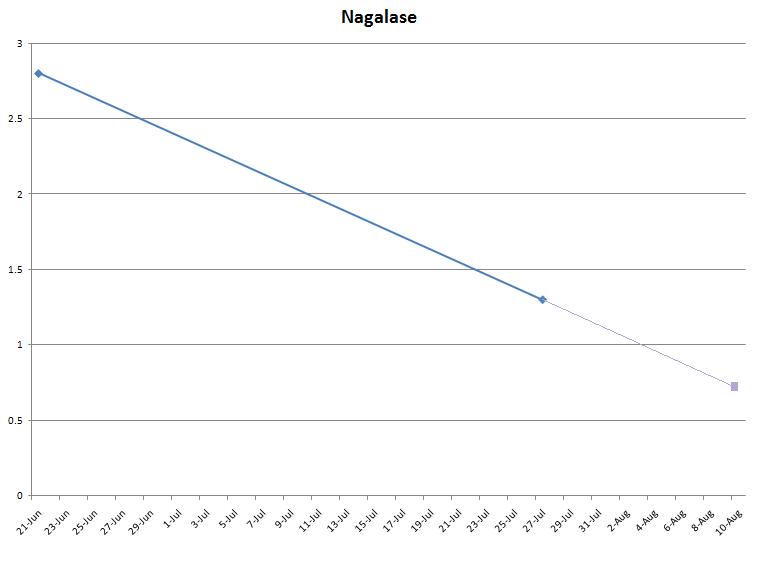
And speaking of cytokine storms, before the appointment, I put together this plot of the two nagalase tests I had done, one before, and one while I was on GcMAF. (Click to enlarge.) The dots on the darker line are the two tests; the lighter line is a linear extension of that trend.

Dr. Cheney said that going into the use of GcMAF, he thought the aim would be to drive nagalase to zero, because zero is the normal value in healthy people. However, as patients arrived there, he found that a nagalase value below 1 appeared to coincide with the onset of a cytokine storm and regression – some cases milder, some more severe. Since then, he’s been counseling patients to stop before we get below 1. My graph definitely fit that pattern – if my nagalase had continued dropping in this roughly linear fashion (which of course, isn’t necessarily the case), it would predict that my cytokine storm would begin approximately where it did.

One of my questions for him was whether it would make sense for me to go back on a low dosage of GcMAF (which several people have suggested to me) or to proceed to MAF 314. He thought MAF 314 would not be a great idea for me, as he said it’s more powerful than chemical GcMAF and more difficult to control, and would increase the likelihood of another cytokine storm. Low doses of the chemical GcMAF, which is a known quantity and strength, was in his opinion be a better idea for me. But, he said, we needed to know where my nagalase was first before embarking on that again. (I had a nagalase draw a week before we went to Asheville, so it shouldn’t be long now.) He said he thought based on my rekindled cytokine storm symptoms related to the cold that my nagalase would turn out to still be below 1. We shall see.

As in years past, he noted with interest my particularly unusual sleep regimen, which I’ve written about here before. I told him that the Soma I’d added last March (which he’d prescribed for me) had saved my bacon, allowing me to knock down my use of Seroquel, and that the particular combination of things I’m on now has been giving me the best sleep I’ve had since I started needing sleep aids in 2007. He said, as he has before, that he thought he might share my protocol with other patients, since I’ve put so many years into figuring out each tiny thing that will help add up to a good night of sleep for me. And he was particularly interested in figuring out why the Soma had made such a difference – he said he planned to investigate its mechanisms. It’s always nice to leave feeling like I’ve contributed something he finds interesting and which might help other patients.

When we went to leave Asheville, because the sun had been so bothersome on the way down, Chimp was kind enough to construct some makeshift blackout curtains in the back seat of the Sequoia for me out of t-shirts and clips, so I wouldn’t have so much light coming in. As we were sitting on Wall Street by Laughing Seed (my fave Asheville restaurant), picking up our lunch, I reached into my bag for my sunscreen. Wondering anew about why I felt so crappy on the way down to Asheville, I turned it over to look at the ingredients. There, staring back at me, some way into the list, were the words “magnesium sulfate.”

Well, no wonder! Magnesium sulfate and I have a long history of not getting along. I’ve tried it in tablet, cream, and injectable forms, and all three have in the past caused tachycardia. So foregoing pants and smearing on at least double and maybe three times the amount of sunscreen I’ve used in years past probably has something to do with why I felt so terrible on the way down. I decided to skip the sunscreen and hope that Chimp’s blackout curtains would do enough to keep the light off of me so I wouldn’t burn. It did seem to work.

And a little personal note: One of the few times I popped my head up on the way home, we were on U.S. 19 in West Virginia, and just passing the exit for Birch River. And I thought to myself, “Isn’t that the home of Brier Run Chevre, or is my PEM-addled mind running the initials together?” Those of you who didn’t know me in my pre-illness life might not know that I was a Whole Foods cheesemonger for five years in the 90s. And indeed, I was remembering right (link autoplays video). The Savas invited me to the farm more than once, and I never did get a chance to get out there. Their cheese was one of the ones I picked for Chimp and my wedding reception, too. I wish I were well enough that we could have stopped.

My recovery from the trip has gone well. It took a few more days for the last of the cold to let go, and I noticed my brain coming back pretty well after just a couple days. The body part has taken a bit longer, but within a week I wasn’t really noticing the “I just went on a trip” post-exertional malaise any more. The one thing that’s been hanging around is the darned feverish feeling. I took some Norco for it for a few days after returning, and since then have been dealing with it by wearing just a tunic and continuing to forego pants. I don’t know if it’s caused by the cold virus or whether the stress of the trip is playing into it too, but I’m hoping it’ll abate faster than it took to do so the last time. Another five months of this would be pretty unwelcome, but if that’s to be the case I can deal with it at the level it’s at currently.

Posted in ME/CFS | Tagged , , , , , , , , | 33 Comments

The End of IRIS

Irises at the Meiji Shrine by Eugene. I hope to Pete this is the last time I need to post a picture of these flowers at the top of an entry.

Well that sucked.

Some of you may remember that I’ve been dealing with IRIS caused by my experimental treatment, GcMAF (see my previous posts, “Everybody Gets Through IRIS” and “Further Adventures in IRIS”, and if you want a brief explanation of GcMAF, read “The Post-Appointment Post”). I started the GcMAF on June 21st with a 20 nanogram dose, and was slowly increasing the amount every five days up to the full 100 nanograms, which I reached on July 31st. August 10th was my seventh dose, and my third at 100 nanograms, and that day was when the IRIS hit.

My birthday is August 12th. This is not among the best birthday presents I’ve ever received.

It wasn’t unusual for me to feel a bit puny, warm, and miserable on the day of dosing, so at first I didn’t realize anything was up, but usually I would feel markedly better the day after. When it didn’t subside the next day, I thought maybe the cumulative effect of the full doses was just causing the dosing yuck to hang around a little bit longer than usual. But when it continued getting worse for days, I realized I was in IRIS.

My expectation, from hearing about others’ experiences, was that it was going to last for a few days, or for two or three weeks at the most. Not only did it not end that quickly, it persisted for five months, finally trailing off around January 10th. Because of that expectation, at some point I stopped calling it IRIS and just called it a cytokine storm.

It wasn’t as bad as it was at the beginning for a whole five months, but those five months have included quite a bit of concentrated misery. The first month, I felt so overheated all the time that I couldn’t manage to keep any clothes on at all. I had never really wondered whether I wound enjoy nudism, but that month allowed me to determine that it really wasn’t for me. In September, I still felt hot all the time, but I was able to go Donald Duck-style – shirt but no pants. I didn’t get pajama pants back into rotation until sometime in  December.

I had originally thought I would restart the GcMAF after the IRIS abated. After all, I still have four months worth of it sitting alongside our summer’s worth of home-grown tomato curry sauce in our chest freezer. But by the time my IRIS got going, Dr. Cheney was working with Marco Ruggiero on a probiotic yogurt version of GcMAF called MAF 314, and getting ready to offer seminars in how to make it. In October, there was a seminar that fit with Chimp’s teaching schedule, and we didn’t know when there would be another one that would, so he went down to Asheville to learn, and came back with the starter.

When my IRIS symptoms finally went away in January – it was five months pretty much exactly, January 10th – the list of pre-MAF 314 tests had been lengthened, and having felt bad for months, I wasn’t really in the mood to do the human pincushion routine again any time soon. So I’ve decided that I’m going to wait until at least after my appointment with Dr. Cheney in March to start on the MAF 314 process. I want to talk to him in depth about the risks, and waiting a little bit longer will allow him to gather more information on how other people are doing on it, and hopefully figure out how those results are likely to translate to me.

I’m not bitter about the IRIS. It wasn’t at all fun, but this is one of those things that comes along with an experimental treatment. I would have rather have been a person who got miraculous improvement out of it and no downside, but there are no sure things in ME/CFS treatment, and I’m very grateful that I seem to have come out of the experience without permanent harm.

I do seem to be doing better than I was before I started GcMAF. I’m able to get my own breakfast these days, and I seem to find myself up slightly more often during the day, though of course I still have to watch how much I do that pretty closely. On very good days, I’ve even done a tiny bit of cooking here and there – things that I can do sitting in a chair for a few minutes, like measuring a few dry ingredients or warming tortillas. I can’t say exactly what is making this possible,  other than continuing to sleep and the Cheney Protocol in general.

I do worry that I might never restart chemical GcMAF – after all, what would I expect to happen if I did, given what happened last time? And depending on how others do and what it seems likely to do to me, I worry that it’s also not a sure thing that I’ll ever even start MAF 314. If I decide I’m not able to do either, that’s certainly money I would rather have saved, but unfortunately, sometimes we have to make decisions without complete information. It’s a sunk cost now. This is the first time in the seven years that I’ve had ME/CFS that something became available to me that seemed like it might be a game-changer, treatment-wise, and I feel like I made the best decisions I could along the way. I know, though, that I’ll undoubtedly have this experience in mind when the next new treatment hotness (heh!) comes along, and I might be more prone to let others be the guinea pigs for a while first.

Posted in ME/CFS | Tagged , , , , | 33 Comments

Nulliparous

Nulliparous: of, relating to, or being a female that has not borne offspring. New Latin nullipara, one who has never borne an offspring, from Latin nullus not any + -para -Latin, from parere to give birth to.

One night in April 2001, at the age of 25, I went to bed with clear skin and woke up the next morning surprised to see a face full of acne staring back at me from the mirror. Once I checked the calendar to be sure I hadn’t somehow unknowingly ridden a time machine back ten years to the glory days of grunge (Grunge, if you’re reading this, I’m still totally bitter about you knocking my preferred type of pop music from the airwaves!) I puzzled over what this could mean. First I bought new makeup. Then I changed my moisturizer. Next I bought some benzoyl peroxide cream and promptly bleached all my purple washcloths a blotchy orange. After a month or so, none of this having helped, I started making doctor’s appointments.

After a few wrong turns, including a dermatologist who dismissed out of hand that my acne could be hormonally motivated (my very first experience with a useless doctor!) eventually an endocrinologist deduced that I’d developed polycystic ovary syndrome, and that I was carrying around about three times the normal amount of testosterone for a woman. Thus the acne and my newfound ability to clean-and-jerk filing cabinets.

I didn’t have all the signs of PCOS, but I had enough. And it made some things about my personal health history suddenly make sense. Now there was an explanation for the fact that my uterus had always been as much of a procrastinator as I was! She had always had an “I’ll have a period…when I get around to it” sort of attitude. Frankly, that suited me fine – having fewer of them, at longer intervals than any of my girlfriends did, had never seemed like a disadvantage to me. Now my gynecologist was telling me that if I wanted to have kids, I had better get started sooner rather than later. Even though the tests showed I was ovulating, it was possible, she said, that I might have trouble conceiving. But let’s step back from 2001 for a moment.

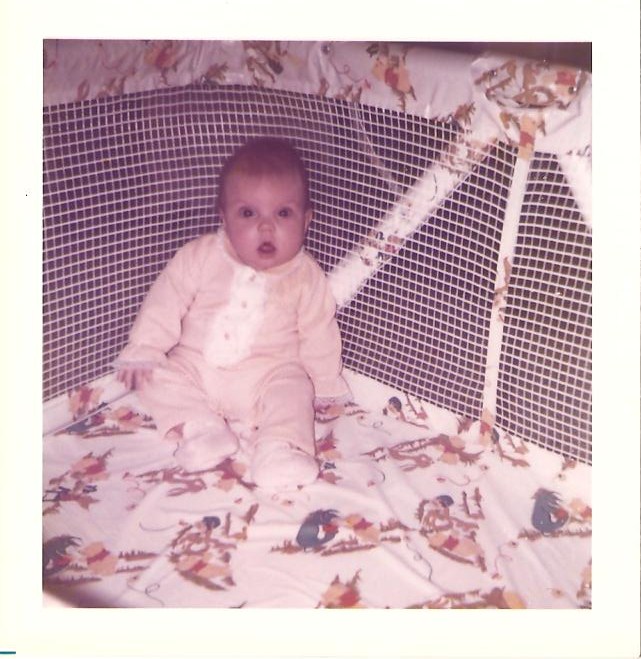
Me, January 1976

When I was a kid, I was not really into baby dolls, besides an occasional interest in the ones you could put water in one end and get out the other and the obligatory participation in the Cabbage Patch Kid craze required of all middle-class children in the 80s. Baby dolls were boring. Barbie was much more my speed – she had an awesome wardrobe and a range of cool jobs, and Barbie was whom I wanted to be like.

As a child, when I looked forward to when I would be grown up, I thought that I’d have a great career and maybe I’d get married. But the idea of kids – it just seemed totally foreign to me. While I did plan to have pets as an adult – always an animal lover, I wanted as many cats as possible – looking into the future, I couldn’t imagine myself having kids. Once I got to the age where there there was some risk of it, I still couldn’t imagine it and I was pretty well terrified of it happening. Well, probably most of us were a bit petrified of it at the age at which it would not have been the done thing in our social circle – but my petrification persisted.

I also never thought I would be particularly well-disposed to parenting. When I observed others engaged in it, it didn’t seem like something I’d enjoy, and I thought that personality-wise, I was too selfish and not patient enough to be a good parent. I felt like I knew myself pretty well, and I thought that the likelihood of changing my mind (as people always say to women who declare they don’t want kids) was low. But maybe there was a slim chance I would change my mind. Maybe, likewise, I’d be more patient and less selfish with some years under my belt. However, at the moment my gyno encouraged me to get started soon, it wasn’t really a good time.

I know; there’s no perfect time, but that moment was particularly inopportune for the two of us. I wouldn’t say we’d absolutely ruled children out at that point, but it definitely hadn’t been on our near-term to-do list at the moment my gyno made that pronouncement. I was back at college full time and working part-time. Chimp was working in a three-year job as a visiting professor, and we didn’t know where we’d be after that. But soon could still mean a few years from now, and I thought that we’d have a chance to revisit the issue when Chimp got a tenure-track job.

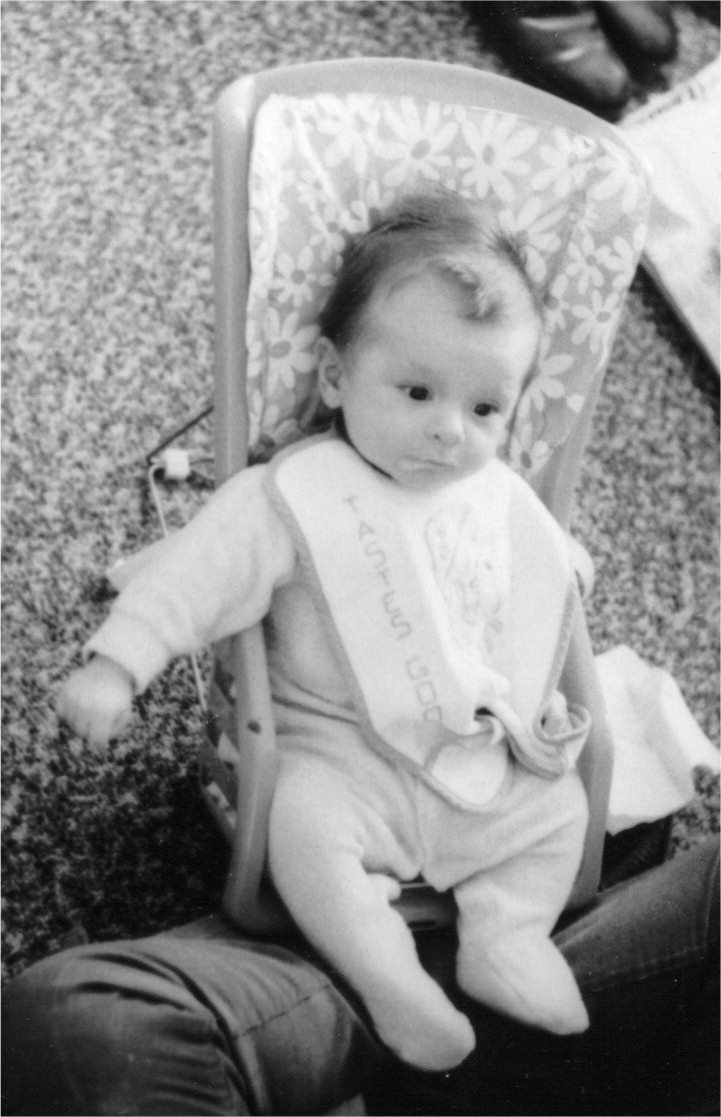
Chimp, 1971

I graduated in 2003, and Chimp landed a tenure-track job in California that same spring. We moved to Fresno in August. (If you ever need to move to Fresno, I would not suggest August as the optimum time to do so, as it’s sort of like moving to the surface of the sun. Actually, the sun might be easier, because you won’t have to drive a U-Haul over the Rocky Mountains to get there. Thanks again, Chimp!) I started my first post-college job at the end of October, and at the start of December, I got the fateful flu shot that kicked everything off.

The idea of kids never had a chance after that. ME/CFS had made the decision for me.

I know there are women who have had children while having ME/CFS. I cannot imagine how they do it. I was so tired even at my best in those mildest first couple years – being pregnant on top of that seemed like an insurmountable obstacle as well as a terrible idea to risk-averse me. What if I had a baby and it made me worse? What if having the baby went okay and then I got much worse years later? How would we ever manage?

In the meantime, I watched from the sidelines as more of my peers’ babies started to be born. At first there were a trickle of births, then a stream, and eventually a flood. I’ve been totally surprised by how many people decided to have children, but I suppose I shouldn’t have been – I’m more the outlier than they are.

Because I never got to have them, I feel fortunate, honestly, that I never really wanted children, and doubly fortunate that Chimp, while probably more interested in the idea than I, didn’t have a such a tie to it that it could become a relationship-ender when I proved unable to carry them.

Maybe if my health hadn’t turned, we might have made a different decision. I’ll admit, when I look at that picture of Baby Chimp, above, I feel a pull to it that I don’t when I see pictures of my friends’ children. I’m sure that’s because we’ve been together for fifteen years, and somehow, my unconscious has gotten programmed to react positively to an infant that looks like my mate. I’ll admit, it would have been fun to see what Chimp and my genes would have looked like combined, and interesting to know the personalities that might have emerged. But neither of those seem like a sufficient reason to reproduce.

I’m sure we could have been happy with children, but these days, when I think about the idea of us having them, it’s hard to evaluate whether it’s having a child that’s appealing, or if it’s that in imagining that scenario, I imagine myself well, and that being well is what’s so appealing. It’s tough to tease those factors out for me. But putting together the possibility of being exactly as sick as I am right now and having a child in our lives as well doesn’t feel good – it feels incredibly stressful. I guess there’s your answer.

In the end, it’s not that difficult to accept that I’ll never be a mother, because the drive was  obviously not strong in me. For those who dearly want children and can’t have them, I gather it’s heartbreaking. However, I am sorry – much more for our parents than for myself – that we didn’t give them the joy of grandchildren. After all, people who have kids would probably like to have grandchildren, too. But none of them have pressured us or complained about it, and for that I’m grateful.

I remember a flight I took on a business trip when I was already sick but still well enough to be working. Just by happenstance, I’d been seated next to an older gentleman who was also in the food business. We got to talking about our respective lines of work. At some point he asked, “So, do you have kids?”

“No. No interest.”

“But you and your husband are obviously smart people. People like you should have kids! And everybody has kids eventually.”

“The kind of people who should have kids are people who want to have kids,” I said.

And when it comes down to it, that was never really me.

Posted in Chimp, Life Before, ME/CFS | Tagged , , , , | 23 Comments

Happy Blogiversary to Me

Photo by Donald Tetto

No Poster Girl is one year old.

It took a long time for me to be convinced to start another blog. Many, many people had suggested it to me, including a bunch of friends who’d followed my old food blog, She Spills the Beans, but I just didn’t think I had that much to say about being too ill to do things like wash my hair. And it turns out I have had a lot to say about things like being too ill to wash my hair, and that shockingly, others will come by and read about me not washing my hair. Hi others!

I want to thank all of you who take time out of your day to come by for doing so. I’m grateful for the visits, the comments, the encouragement, the sympathy. I’m grateful to the well for being interested enough to learn about those of us who are sick and grateful to those of you who are sick for spending some of your precious energy here.

I think the rise of ME/CFS blogs is one of the greatest things to happen to the ME/CFS community. After I was diagnosed, it was several years before I personally knew somebody else with the disease. And now, through blogs (and the power of facebook and twitter), I know tons of somebodies with the disease, and we’re able to harness our collective (low) energy to support each other and for activism’s sake.

So since I’ve finished up a year here, I thought I’d do a bit of a roundup. It’s been an interesting year. I expected to talk about myself, but I’ll admit I didn’t expect to end up in the middle of a charity contest controversy – twice!

I started out by explaining the blog’s title, then bringing some questions I’d answered on my formspring over: Alphabet Soup ME/CFS vs. Fibro | Current Treatment | Where Did You Get It? | One Fine Day How It Feels

I bought a Zeo (and later returned it), we went over my 56 pills a day, and I explained the basics of the disease a bit. Then I had a crash.

We talked about the most famous ME/CFS patient, my house, the disaster that was the PACE trial and the CAA’s response to it.

I got a fever, explained why I would make a great criminal, worried about making the right treatment choices, and discovered where the fever came from.

I put down in pixels a four-part story of how my illness began: The Flu Shot | Chicago | Chicago Once Again | The Crash and the Aftermath.

I tested negative for XMRV, put together a primer on the disease, went for my third annual appointment with Dr. Cheney, and detailed my infamous, fearsome insomnia in a two-part series.

Then there was a bit of a digression in the form of that little kerfuffle with certain charities cheating in Chase Community Giving. I | II | III | IV | The End

We dealt with another digression in the form of the editorial expression of concern.

I got back on topic with a post on how the illness has had an unusual effect on my figure with Thin Thighs in 35 Years, and then promptly off topic again when certain groups proved not to be playing fair in Vivint Gives Back, but this time, we got a better resolution. I | II | III | IV | V

I talked about managing the everyday, found myself in IRIS, talked about illness words and what they mean to me, dealt with more IRIS, ranted about the illness narrative, gave some advice about what I learned the hard way, let Chimp have his say twice, and talked about my teenage battle with depression and how it’s different than ME/CFS.

And that brings us to to the beginning of year two. Thanks for coming along for the ride, y’all.

Posted in Blog Updates | 23 Comments

My Sergeant Pepper Moment

[Edited 3/28/22 to add: I pulled this up to link back to it recently and I realized it has the order of events reversed. I’m not sure how I made this error, but I seem to say below that I started the Prozac after the auditory hallucinations, and I know that’s incorrect. I started the Prozac in late November 1991 and the hallucinations started shortly after that. They were at their worst in mid-January 1992, and then they receded. At the time I wrote this in 2012, I didn’t know that hallucinations are a possible side effect of Prozac; I believe I’ve only learned that in the past decade. In 1992, when these events happened, none of the psychiatrists or psychologists I saw mentioned it to me either. I usually correct small errors here without a comment, but this would require such an overhaul of the post that I’m placing this introductory note instead. Is this mistaken remembrance down to brain fog in 2012? I really don’t know.]

The middle of winter marks a mixed bag of anniversaries for me. I’ve always been a bit – well, nostalgic isn’t the right word here. I’ve always marked anniversaries, as a way, I guess, to measure where I’ve been and where I am. So at this point I’ve been bedridden for four years (okay, I’m ready to graduate already) and a vegetarian for 21 (V8 and vodka all around!).

And today marks the 20th anniversary of an important event in one of the darkest periods of my life.

Twenty years ago today I was hospitalized for depression.

I think some people might not want to talk about something like this. However, it was impressed upon me from an early age that it was perfectly normal to seek mental health care – getting help for those sorts of problems had no more stigma in my family than getting it for physical ones. So admitting that I’ve been a psychiatric inpatient has never bothered me.

In January 1992, I was in 11th grade. The school system I grew up in is a large and well-regarded one, and there was a lot of pressure to do well. For my all-important junior year (if you don’t do well junior year, you won’t get into a good college, and if you don’t get into a good college, you fail at life), I’d ratcheted up my schedule a notch so that all my academics were honors or AP classes. And by the end of the fall, I was totally overwhelmed – and totally depressed.

(There was a guy involved in this, too, but we’ll leave him out of it for his privacy’s sake. And, well, okay, for my privacy’s sake too. I know, I’m usually totally willing to tell the whole internet my business, but I’m leaving that part out. Honestly, that’s the only part of this that’s embarrassing. To be diagnosed with major depression? Fine. To be depressed (partially) over a guy? Mortifying.)

Anyway, I’ve forgotten a lot of things about high school, fortunately or unfortunately, but let me tell you, I remember exactly what it was like to be that depressed. It was, as you’d expect, complete misery.

To be that depressed – the way I described it, at the time, was that it was like having emotional mono.

I’d had friends with mono by that point, and that really was what it reminded me of most, because the depression left me overwhelmingly exhausted much of the time. Before that winter, I’d had no idea that mental illness could be so physical. Everything was a titanic effort. Trying to ford the constant tide of sadness to get done the things I was supposed to be doing was almost impossible, and the less I accomplished, the more hopeless I felt.

There were many days when I woke up and couldn’t force myself out of bed. My limbs wouldn’t obey me, and I would lie there watching the sun and shadows slide across the room until dinnertime. I didn’t much care what happened in the world outside, anyway – I was trying so hard to merely keep afloat that I didn’t have any energy left to do so.

In addition to the tiredness, I felt like my skin had been peeled off and I was walking around as one big raw mass of exposed nerves. Emotionally, everything hurt, all the time. Going out into the world was one unbearable wound after another, and I would just try to endure it until I could go home and fall apart again.

But even retreating from the world wasn’t enough sometimes, because the littlest thing would throw me into floods of tears. I remember one particular afternoon I was cleaning my room and tripped over the phone cord. The sudden startle of it set me crying – and I slumped down on my bed and cried for the rest of the afternoon.

The depression was so bad that I started to have auditory hallucinations, first when going to sleep at night, and then increasingly during the day. On Monday morning, January 13th, 1992, at the beginning of drama class, I stopped being able to keep the voices at bay, and I collapsed into a breakdown. And that was the point at which my really good shrink decided that it was time for me to be hospitalized for a bit.

Thank heavens for a really good shrink, and for prescription antidepressants.

I went on Prozac, which was the miracle drug of the era. If you’ve never been on an antidepressant, being on one doesn’t make you suddenly happy. What it does do is take away that terrible raw feeling, and it replaces it with numbness. I’ve always described it as like living in one of those balls you put hamsters in to let them get some exercise outside their cage. You put them in it, and they go roll roll roll bonk into one wall, and then roll roll roll roll roll roll roll roll bonk into another wall. You’re at a bit of remove from the world, and you don’t really feel much of anything, but when you’re really depressed, that’s better that feeling everything, too much, all the time.

Thankfully, a few weeks in the hospital and getting established on Prozac gave me enough improvement that the hallucinations receded and I started managing a little better. I dropped a couple classes I didn’t need the credits in and converted that time into a personal study hall, trying to catch up on all the work I’d fallen behind on. At the end of the school year I passed all but one of my classes. (Algebra II Honors. Why on earth did I take honors math? I should have known myself better than that.)

I stayed on Prozac for a couple years, but that year proved to be the worst of the depression. I wasn’t really sure whether I was going to need Prozac permanently or not. I think I dropped it my sophomore year of college, and I’ve never felt a need for it since.

I actually have rambled on and on here telling this story for a reason.

When I first fell ill with ME/CFS, the first internist that I saw – who came well-recommended – listened to my litany of sudden, out-of-the-blue health weirdness, and when I finished, offered me a prescription for an antidepressant. I remember bristling at the suggestion.

“How is that supposed to help?” I said. “I’m not depressed. I’ve been depressed. I know what it’s like to be depressed enough to need medication. This is not depression.”

She looked at me blankly. She didn’t answer. She had no other treatment ideas. I never went back to her.

I try to give that doctor the benefit of the doubt. Faced with a young woman with a (long-ago) history of depression marked down on her chart, who’s tired all the time and is having trouble doing the things she needs to do, I can forgive her assumption. She did brush off my long list of bizarre physical symptoms, but it’s not the worst that a doctor’s treated me in the years I’ve had this disease.

The difference, though, the big difference, the gulf of difference between tiredness from depression and tiredness from a physical illness, any physical illness, which is pretty easy to discern, is the presence or absence of anhedonia – lack of pleasure from activities usually found enjoyable. This is what every person who’s experienced both depression and ME/CFS, and every doctor who knows anything about both will tell you.

When I was depressed, I didn’t want to do anything. Nothing sounded appealing. Nothing was fun. I mostly just wanted to be left alone with my (depressing, hopeless) thoughts. But if you asked me, presently, what I’d like to do if I woke up one morning and was miraculously feeling better – well, I’d run out of energy to talk before I would run out of things that I’d like to do. (I actually answered this question on my pre-No Poster Girl formspring account.)

Is it depressing to be sick all the time? Sure it is. But just because I’m sick all the time doesn’t mean I’m depressed all the time, or even often. While of course I’d rather be well, I’ve gotten about as used to being this sick as one can, and I do my best to enjoy myself within my abilities.

But maybe that’s all the sedating antidepressants I take to help me sleep talking.

Posted in ME/CFS | 33 Comments

Chimp Speaks, Part II

“In Thought” by irishwildcat

This is the second half of the contribution my husband, Chimp, asked to make to the blog. Part I is here.

Maybe you went to bed last night with the whole thing figured out, and you think you’ve written a third story.  But The Disease got up two hours before you, had four cups of coffee and reinvented itself after it read your draft.  You wrote that story – and a hundred drafts before it – because you wanted to feel like you controlled The Disease, that the world would behave itself if you pushed the right buttons in the right order.  But you do not control The Disease.  You cannot control it for her, and you cannot control what her suffering does to you.  You live a life where those things you cannot control are pushed to the fore.  You cannot stop resisting it, because doing so is walking out on her.  You must become someone who is not diminished by these things.  How do you live a life where what matters most is not in your control?

Continue reading

Posted in Chimp, ME/CFS | Tagged | 23 Comments

Chimp Speaks, Part I

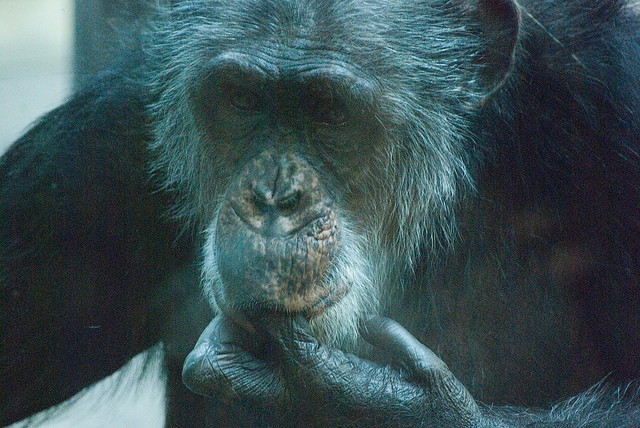
“Thinking Chimp,” by windelbo.

This is an entry by my husband, Chimp. No, I’m not actually married to a philosophizing simian – “Chimp” is his longtime internet handle. – Jocelyn

Jocelyn asked me if I’d contribute something to No Poster Girl, and I wrote some things that I eventually thought might be fit for the light of day. She could use a week without the pressure of crafting an entry, and I am trying to work my way through a year-long bout of writer’s block.   I don’t think I can tell her story as well as she does, and I won’t try.  I have nothing to add about the disease itself that others won’t say better than I can.   So instead of those things, maybe I could write some things about what my part in our story is like.  I will warn you that I talk for a living, and I can talk for a long time.

Continue reading

Posted in Chimp, ME/CFS | Tagged | 45 Comments